The Price of Free Intelligence

Why China is opening its strongest AI models—and where the profits may move next.

SOLTEN & CO. RESEARCH | FLAGSHIP REPORT | 31 AUGUST 2026 | VERSION 1.0

AI Models / Infrastructure / Cloud Economics / Capital Allocation

CENTRAL THESIS: Chinese laboratories are not giving intelligence away. They are reducing the price of model access to accelerate adoption, shape technical standards, and redirect demand toward paid inference, cloud infrastructure, enterprise products, and applications. The strategy is already economically visible at Alibaba, but it is not proven across the private labs—and it can be disrupted by serving cost, regulation, security concerns, or government restrictions.


Research snapshot

Field Detail
Publication date 31 August 2026
Evidence cut-off 21 August 2026
Research type Flagship thematic and market-structure report
Primary audience Family offices, venture/growth investors, lean investment teams and strategy leaders
Estimated reading time 30–35 minutes
Venture Deal Protocol Not applicable: this report does not underwrite a financing or acquisition
Core evidence boundary Public data measures releases, prices, downloads and one listed company’s segment economics; it does not reveal private-lab gross margins or production workload share

Executive summary

China’s leading AI laboratories are releasing model weights at a scale that would once have been treated as proprietary crown jewels. In August, Alibaba released weights for the 2.4-trillion-parameter Qwen3.8 flagship; Moonshot’s 2.8-trillion-parameter Kimi K3, DeepSeek V4, MiniMax M3 and Z.ai’s GLM family had already established a pattern. The immediate interpretation—China is giving away its best models for free—is memorable and incomplete. What is free is usually a licence to download weights. Training data, full reproducibility, reliable serving, compute, security, support and enterprise integration remain scarce or paid. Some licences also impose commercial conditions.[1]–[13]

The strategic logic is a substitution: sacrifice model-layer scarcity to acquire distribution. Open weights lower switching and experimentation costs, invite community optimisation, create derivatives and make a model family available through many clouds, gateways and on-premise stacks. That reach can stimulate demand for hosted APIs, cloud compute, accelerators, inference optimisation, security, evaluation and model-enabled applications. It can also influence which architectures and tooling conventions become defaults. Hugging Face counted 151,448 Qwen derivatives and roughly 180–210 new Qwen-based repositories per day during the first seven months of 2026. It simultaneously warned that Hub metrics are not commercial market share.[14]

Alibaba provides the clearest public evidence that the model can work. For the June 2026 quarter, its AI Cloud and Compute Services revenue rose 45% year over year to RMB48.4 billion and adjusted EBITA rose 133% to RMB5.6 billion. Alibaba also reported more than three billion Qwen downloads and more than 300,000 derivatives, while saying AI-related product revenue had delivered a twelfth consecutive quarter of triple-digit growth. Capital expenditure rose 75% to RMB67.7 billion. This is consistent with open models feeding a full-stack cloud business; it does not isolate Qwen’s causal contribution, and it shows that the strategy is capital intensive.[17], [18]

The strategy is not uniform. Qwen releases models across a broad size range, inviting developers to standardise on one family from local deployment to frontier workloads. Moonshot, Z.ai and MiniMax lead with very large models that few developers can serve directly; open weights create attention and distribution, but their paid APIs and subscriptions remain the practical product for many users. DeepSeek combines permissive MIT releases with official API prices far below U.S. frontier services. These are different business models, not evidence of a single centrally directed commercial plan.[4]–[14]

For investors, the consequence is a value migration rather than value destruction. Standalone model API pricing is under pressure. Compute demand, inference throughput and optimisation can expand. Enterprise control points—security, evaluation, observability, orchestration, proprietary data and workflow integration—become more important as model choice commoditises. Application companies can gain from lower variable cost, but only if competition does not pass the entire saving to customers. The most exposed companies are model vendors whose differentiation rests on generic capability and whose monetisation does not extend into cloud, distribution, proprietary data or workflow ownership.

The counter-thesis is substantial. The largest open models are expensive to serve: raw BF16 weight memory is approximately 4.8 terabytes for Qwen3.8’s 2.4 trillion parameters and 5.6 terabytes for Kimi K3’s 2.8 trillion, before runtime overhead. Download counts can reflect curiosity, mirrors or automated pipelines rather than durable production. Security review, censorship behaviour, licensing ambiguity and geopolitical restrictions can block enterprise adoption. Reuters reported that Chinese authorities had discussed possible limits on overseas access to advanced models; no policy decision had been confirmed at the evidence cut-off.[2], [4], [14], [26]

Our conclusion is conditional but decisive: the topic merits fundamental coverage because open-weight competition changes the price of intelligence, the geography of standards and the profit pools around AI. The investable signal is not another benchmark victory. It is whether open-model distribution converts into paid inference, cloud utilisation, enterprise deployments and application gross profit without destroying the margins needed to fund the next generation.

Key findings

  • ‘Free’ is a distribution choice, not a cost structure. Most releases provide weights; they do not provide training data, full reproducibility, serving or enterprise assurance.
  • China is not a single actor. Qwen’s full-spectrum strategy aims at developer standardisation; frontier-first labs use open releases as demand generation, credibility and ecosystem leverage.
  • The strongest monetisation evidence is Alibaba’s cloud segment. It supports the mechanism but does not prove that every private lab can reproduce it.
  • Open-model adoption is real but poorly measured. Derivatives and downloads indicate ecosystem activity; they do not reveal production workloads, routed dollars, retention or gross margin.
  • Licences are becoming a strategic variable. DeepSeek and GLM use MIT for major releases, while Qwen3.8 and MiniMax M3 use custom terms that can limit or condition commercial use.
  • Frontier API prices span orders of magnitude. DeepSeek V4 Pro lists $0.435 per million uncached input tokens and $0.87 output; OpenAI GPT-5.6 Sol lists $5 and $30; Anthropic Claude Fable 5 lists $10 and $50. Capability, latency, support and safety are not normalised.
  • Open weights benefit cloud and hardware only if lower prices expand workload volume faster than unit margins compress. Capex and power remain unavoidable.
  • The model layer can retain strategic value even if direct licensing value falls: model defaults influence toolchains, hardware optimisation, application design and standards.
  • The largest threats are regulatory bifurcation, security concerns, serving economics, custom licence friction and a renewed capability gap in favour of closed models.
  • The decisive 12–24 month indicators are production spend, enterprise deployments, paid API mix, cloud segment economics, independent capability-per-dollar, and any export or access restrictions.

Contents

Sections 1–8 Sections 9–15
1. What is actually being given away 9. Value migration across the AI stack
2. The August 2026 release wave 10. Industrial-policy and geopolitical logic
3. Two open-model strategies 11. Counter-thesis and falsification
4. The economics of distribution 12. Scenarios for 2027–2029
5. Evidence that monetisation is occurring 13. Investor implications
6. Pricing pressure and deployment reality 14. Open questions and monitoring triggers
7. Adoption: strong signal, weak instrument 15. Conclusion
8. Licences, openness and control Methodology, limitations and sources

1. What is actually being given away

The phrase ‘open source’ conceals several different bundles. A fully reproducible system would disclose weights, architecture, inference code, training code, data provenance and a licence permitting modification and redistribution. Most frontier releases provide weights, architecture descriptions and enough code to run inference. They do not disclose the complete training corpus or a recipe that lets a third party recreate the model. The more precise term is open weight.[24], [25]

That distinction is economically important. A developer may avoid a per-token licence toll by downloading the weights, but still needs storage, accelerators, high-bandwidth memory, networking, serving software, optimisation, monitoring, security and people. For very large mixture-of-experts models, only part of the parameter set is active for each token, reducing compute relative to a dense model. The full weight set must nevertheless be stored and made available to the serving system. Quantisation can reduce memory; runtime state, redundancy and the key-value cache add it back.

Exhibit 1. The cost stack behind a free model
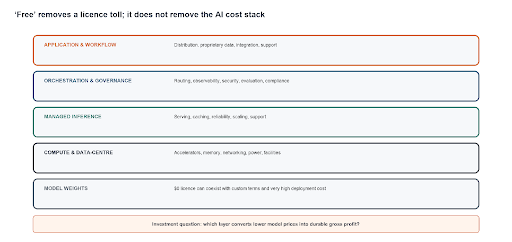
Source: Solten & Co. framework. A zero licence price does not imply zero total cost of ownership.

Model Total / active parameters Approx. raw BF16 weight memory Release / licence boundary
Qwen3.8-2.4T-A95B 2.4T / 95B 4.8 TB Weights released; custom Qwen3.8-Max licence
Kimi K3 2.8T / vendor-disclosed MoE 5.6 TB Weights released; custom terms
DeepSeek V4 Pro 1.6T / 49B 3.2 TB Official open weights; MIT
GLM-5.2 744B MoE 1.49 TB Weights released; MIT
MiniMax M3 ~428B / ~23B 0.86 TB Weights released; custom community licence

Memory figures are arithmetic: parameter count multiplied by two bytes, expressed in decimal terabytes. They exclude quantisation, runtime overhead, cache, redundancy and multimodal components. They are deployment-scale illustrations, not hardware bills.[2], [4], [6], [9], [12]

2. The August 2026 release wave

Alibaba’s August release brought the argument into focus. Qwen3.8-Max launched first as a managed multimodal model. The company then released a 2.4-trillion-parameter, 95-billion-active text checkpoint on 12 August and a 27-billion-parameter model on 14 August. It was the first open release at Alibaba’s Qwen-Max scale. The open checkpoint and managed service are related but not identical: the hosted product adds vision, longer default context and integrated tools.[1]–[3]

The surrounding market makes the release structural rather than episodic. Moonshot introduced Kimi K3 in July with 2.8 trillion parameters and a one-million-token context window, distributed through weights, a consumer product, Kimi Code, Kimi Work, enterprise subscriptions and a paid API. Z.ai released GLM-5.2 under MIT in June and announced GLM-5.3 in August, with weights scheduled after additional safety work. DeepSeek’s V4 family combines a 284-billion-class Flash model and a 1.6-trillion-parameter Pro model under MIT. MiniMax M3 provides a 428-billion-parameter multimodal model under a custom community licence.[4]–[13]

Family Latest relevant release Open-weight status Paid surface Investor-relevant caveat
Qwen Qwen3.8 Max / 2.4T-A95B Released; custom licence Alibaba Cloud, QwenWork, apps Strongest public cloud monetisation anchor
Kimi K3, 2.8T Released; custom terms API, subscriptions, enterprise Serving scale makes hosted access practical
DeepSeek V4 Flash / Pro Released; MIT Official API Extremely low list price; private economics undisclosed
Z.ai GLM-5.2 / 5.3 5.2 MIT; 5.3 promised API, coding plans Release timing and product version can diverge
MiniMax M3, ~428B Released; custom licence API, agent and subscriptions Commercial authorisation threshold in licence

Vendor evaluations show these models close to the frontier on selected coding, agentic and long-context tasks, but no model is uniformly best. Harnesses, reasoning budgets, hardware, prompts and task mix differ. We use benchmarks to establish that the releases are strategically credible, not to crown a global winner.[2]–[7], [30]

3. Two open-model strategies

The release portfolios reveal two strategies. Qwen and parts of Tencent cover the full range from small local models to frontier systems. That lets a developer learn one family, fine-tune it, deploy a small version on-device and move to hosted frontier inference without changing the conceptual stack. The commercial prize is standardisation. Hugging Face reports that Qwen’s 2026 portfolio generated roughly 2.05 billion downloads across repositories with declared parameter counts—about 55 times Moonshot’s frontier-only portfolio—and 151,448 derivatives.[14]

Moonshot, Z.ai and MiniMax publish far less below 70 billion parameters. Their largest models are too expensive for most developers to serve directly, so the open release works as proof, distribution and a community-optimisation seed. Quantised variants appear quickly; third-party inference providers add access; the laboratory sells an official API, coding plan, consumer subscription or enterprise service. DeepSeek sits between the categories: its permissive releases achieve enormous distribution, while its official API is priced aggressively enough to compete with self-hosting for many workloads.[4]–[14]

Exhibit 2. Two different routes from openness to economic value
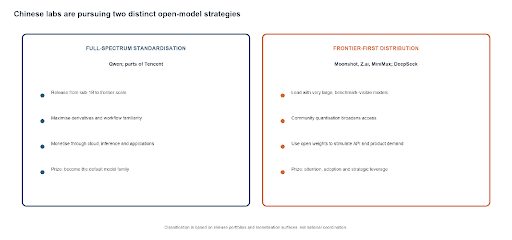
Source: Hugging Face release-portfolio analysis; company product disclosures; Solten & Co. classification.

This diversity matters for underwriting. Alibaba can subsidise model R&D with e-commerce cash flow and monetise through a large cloud. A venture-backed laboratory must turn attention into paid inference, subscriptions, enterprise contracts or strategic financing before cash runs out. The same open-weight tactic therefore has different runway, pricing and bargaining implications across firms.

4. The economics of distribution

Opening weights changes the customer-acquisition equation. A closed API asks developers to trust one vendor’s economics, availability and roadmap. An open model can be downloaded, inspected, fine-tuned, mirrored, quantised and offered by competing hosts. Each new deployment becomes a distribution endpoint the originating lab did not have to finance. Derivatives add languages, domains, formats and hardware targets. The community absorbs part of the optimisation expense.

The return can arrive through five channels. First, a laboratory can sell an official managed API to users who prefer reliability to self-hosting. Second, a cloud provider can monetise storage, accelerators, networking and inference. Third, the model can pull users into an application or subscription. Fourth, broad adoption can influence libraries, evaluation conventions and hardware optimisation. Fifth, ecosystem position can improve financing and strategic bargaining power even before operating profit appears.[14], [19], [20]

The strategy resembles loss-leader economics but with an important difference: model weights are non-rival digital assets. Once released, the marginal distribution cost is low, but the strategic concession is irreversible. Competitors can study, modify and serve the model; the originator cannot later restore exclusivity. The bet is that adoption, iteration and complementary revenue exceed the lost option value of keeping the model closed.

Concession Expected return Evidence available Evidence still missing
Zero / low licence price Faster adoption and derivatives Downloads, repositories, provider listings Production share and customer retention
Replicable serving Broader distribution Third-party hosts and quantisations Originator’s paid share of demand
Community modification Faster optimisation and localisation Derivative models and ports Value captured by the original lab
Benchmark visibility API and subscription demand Launch traffic and price pages Cohort conversion and gross margin
Hardware compatibility Cloud / chip utilisation Vendor integrations Incremental revenue attributable to model

5. Evidence that monetisation is occurring

Alibaba is the observable case. The company’s June-quarter release reports RMB48.437 billion of AI Cloud and Compute Services revenue, up 45% year over year, and RMB5.628 billion of adjusted EBITA, up 133%. The implied adjusted EBITA margin was approximately 11.6%. AI-related product revenue reached RMB12.38 billion and continued triple-digit growth for a twelfth consecutive quarter. The company reported RMB67.7 billion of quarterly capital expenditure, up 75%.[17], [18]

Management explicitly describes the full-stack logic: open Qwen models create reach; training, development and inference run on Alibaba Cloud; the company also supplies chips, servers, storage, networking and applications. Qwen had more than three billion company-stated downloads and more than 300,000 derivative models by the earnings date. That is consistent with a distribution flywheel.[17], [19], [20]

WHAT THE ALIBABA EVIDENCE PROVES—AND WHAT IT DOES NOT  It proves that a company pursuing open-model distribution can simultaneously grow a large, increasingly profitable cloud segment. It does not prove that Qwen caused the growth, that every Qwen deployment runs on Alibaba Cloud, or that a standalone model laboratory can fund the same strategy.

The private-lab evidence is thinner. Kimi sells token-based API access and tiered consumer subscriptions; Z.ai sells API access and coding plans; DeepSeek operates an aggressively priced API; MiniMax sells APIs and applications. These paid surfaces refute the claim that the companies reject monetisation. Public sources do not establish revenue mix, inference gross margin, retention, subsidy levels or the share of open-weight users that convert to paid services.[4], [5], [8], [11]–[13]

Capital formation is a second, weaker form of evidence. Ecosystem traction supports valuations and access to strategic partners. It is not evidence of durable unit economics. For investors, the distinction between financing validation and customer validation is essential.

6. Pricing pressure and deployment reality

Official list prices show how aggressively Chinese providers can attack the hosted layer. DeepSeek V4 Pro lists $0.435 per million uncached input tokens and $0.87 per million output tokens. Z.ai lists GLM-5 at $1 and $3.20. Kimi K3 lists $3 and $15. OpenAI lists GPT-5.6 Sol at $5 and $30, while Anthropic lists Claude Fable 5 at $10 and $50. Qwen3.8-Max’s international Model Studio price is CNY14.988 for input and CNY44.965 for output.[5], [8], [11], [21]–[23]

Managed model Uncached input / 1M Output / 1M Context Boundary
DeepSeek V4 Pro $0.435 $0.87 1M Official list; capability and service levels not normalised
Z.ai GLM-5 $1.00 $3.20 200K Current developer price; GLM-5.3 price not yet listed
Kimi K3 $3.00 $15.00 ~1M Cache-hit input is $0.30
OpenAI GPT-5.6 Sol $5.00 $30.00 ~1.05M Short-context standard list price
Anthropic Claude Fable 5 $10.00 $50.00 Vendor service Global API list price
Qwen3.8-Max intl. CNY14.988 CNY44.965 1M Currency intentionally not converted

On list price alone, DeepSeek V4 Pro is about 11.5 times cheaper than GPT-5.6 Sol on uncached input and 34.5 times cheaper on output. The comparison is illustrative, not a price-performance verdict. Models differ in quality, tokenisation, reasoning-token consumption, latency, uptime, safety, data handling, regional availability and support. Enterprise contracts can also diverge materially from list price.[11], [22]

Self-hosting is not automatically cheaper. The economic choice depends on utilisation. A fully provisioned cluster can be attractive at sustained volume, strict data-sovereignty requirements or specialised optimisation. At low or bursty volume, managed inference converts fixed capacity into variable cost and absorbs reliability engineering. Open weights expand the option set; they do not make every customer a cloud operator.

7. Adoption: strong signal, weak instrument

The evidence for ecosystem reach is unusually strong. Hugging Face reports Chinese frontier models exceeding U.S. open releases in scale in almost every month of 2026. Qwen-based repositories reached 151,448 derivatives, and Qwen added roughly 180–210 derivatives per day in the first seven months. The ATOM Project reports Qwen rising from about 1% of new fine-tunes and adaptations in January 2024 to 69% in February 2026. AP reported that the five most-used models on OpenRouter over a recent month were Chinese and that Kimi consumer downloads accelerated after K3.[14]–[16]

The same evidence contains its own warning. Hugging Face found that 85.6% of model repositories had fewer than 200 lifetime downloads and that 1.5% of repositories accounted for 99.2% of downloads. Only one repository appeared in both the year’s top-25 lists by downloads and likes. Small models below one billion parameters accounted for 83% of all-time downloads among repositories declaring size; models above 100 billion accounted for 1%. Attention, adoption and production are different variables.[14]

Downloads can be triggered by mirrors, automated pipelines and repeated environments. API usage omits private deployments; private deployments omit hosted APIs. Derivatives count experimentation and ecosystem labour, but not users or revenue. OpenRouter token shares are provider-specific and can shift with price promotions. A credible market-share measure would combine routed spend, production tokens, active deployments, renewal and workload criticality. No public dataset does this comprehensively.

Metric Useful for Unsafe inference
Downloads Distribution and pipeline activity Commercial share or unique users
Likes / launch traffic Attention and developer interest Durable adoption
Derivatives Community investment and standardisation Originator revenue
Router token share Hosted workload momentum All deployment channels
API list price Competitive posture Realised price or gross margin
Named enterprise deployments Production credibility Portfolio-wide penetration

8. Licences, openness and control

Licensing is becoming a monetisation surface rather than a footnote. Hugging Face found that 59% of 178 Chinese releases above 20 billion parameters in 2026 used Apache 2.0 and 22% used MIT. DeepSeek and Z.ai released major frontier models under MIT. The latest largest releases are less uniform: Qwen3.8 uses a custom licence, and MiniMax M3 requires attribution for commercial use and prior written authorisation above a $20 million annual-revenue threshold.[2], [6], [9], [13], [14]

This makes ‘free’ conditional. A company may be able to test, modify and deploy without paying the lab, yet still face attribution, usage, revenue or geographic terms. Licences can change between generations. The practical switching cost is therefore not only technical compatibility; it includes legal review and the risk that a future flagship has different conditions.

Control also survives outside the licence. The laboratory chooses release timing, safety tuning, documentation, tokenizer and architecture. The hosted version can include tools, multimodality, longer context, faster inference and support not present in the checkpoint. A lab can open yesterday’s weights while monetising today’s integrated product.

9. Value migration across the AI stack

Exhibit 3. Where value can move as model access gets cheaper
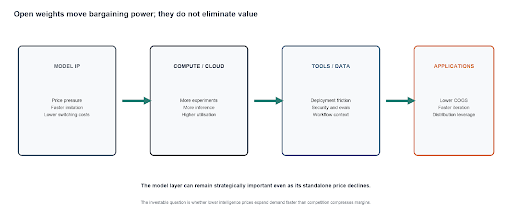
Source: Solten & Co. value-chain framework.

Model commoditisation is not binary. Frontier capability can retain a premium while adequate capability becomes abundant. Most enterprise tasks have a threshold: once accuracy, reliability and latency are sufficient, cost, data control and integration dominate. Open models accelerate competition below the absolute frontier and make model substitution easier. This pressures generic API margins and increases the value of routing, evaluation and proprietary workflow context.

Compute and cloud can benefit through an elasticity effect. Lower prices stimulate experiments, longer contexts, more agentic steps and more users. If token demand rises faster than unit prices fall, total inference revenue grows. Hardware vendors also use open models to demonstrate and optimise their systems. Hugging Face notes that NVIDIA and AMD were the most prolific U.S. model publishers in 2026 and interprets the releases as a route to chip demand.[14]

Tools and applications face a more selective outcome. Gateways, observability, security, evaluation and optimisation become valuable because model choice multiplies operational complexity. Application companies benefit if lower inference cost improves contribution margin or enables new usage. They lose the advantage if every competitor accesses the same models and passes savings to customers. Distribution, proprietary data and workflow ownership—not model access alone—determine who keeps the surplus.

Layer Likely first-order effect What creates durable value Principal risk
Frontier model APIs Price pressure below the top capability tier Unique capability, trust, distribution Adequate open substitutes
Cloud / inference Higher workload volume Utilisation, cost curve, capacity Capex and price competition
Chips / systems More serving demand and optimisation Performance per watt and ecosystem Domestic substitution / export controls
Deployment tooling More complexity and choice Workflow data, governance, switching Cloud bundling
Applications Lower variable cost Distribution and proprietary context Savings competed away

10. Industrial-policy and geopolitical logic

Open models also serve an industrial strategy. The U.S.-China Economic and Security Review Commission argues that low-cost, open-weight deployment can create two feedback loops: a digital loop of adoption and iteration and a physical loop in manufacturing, robotics and research that generates specialised real-world data. The paper treats China’s compute constraints, state support and industrial base as reinforcing conditions. It is a policy analysis, not neutral proof of commercial causality.[24]

Stanford HAI’s review is useful because it resists a monolithic account. Chinese firms vary in licence, architecture, target users and relationship to the state. Export controls may have encouraged efficiency and openness, but academic work finding association between U.S. policy and developer engagement does not establish a clean counterfactual. The observed ecosystem is the product of company strategy, capital constraints, cloud economics, policy support and developer demand.[25], [28]

Standards influence may be the largest long-duration prize. A widely fine-tuned model shapes toolchains, file formats, inference kernels, evaluation practice and developer skills. Hardware vendors optimise around it; universities teach it; applications inherit its behaviours. Those complements can persist even when another model wins the next benchmark.

Geopolitics can reverse the distribution advantage. Reuters reported in July that Chinese authorities had discussed restricting overseas access to advanced models, including open and closed systems; the scope was undecided and ministries and companies did not confirm the discussions. U.S. policymakers have also debated restrictions on Chinese models. A bifurcated market would reduce global scale but increase demand for sovereign hosting, regional clouds and compliance tooling.[26], [27]

11. Counter-thesis and falsification

A strong thesis must specify what would make it wrong. The first possibility is that open-model activity is mostly attention. Downloads and derivatives may fail to convert into production workloads, paid APIs or enterprise renewal. The second is that serving cost overwhelms the distribution benefit: very large checkpoints remain impractical outside specialist hosts, and official APIs price below sustainable economics. The third is that closed labs preserve a large capability or reliability gap and can continue charging a premium.

The fourth failure mode is institutional. Security teams may reject Chinese models because of data governance, supply-chain review, content behaviour or policy uncertainty. Custom licences may deter commercial use. China may limit overseas access, or the United States and allies may restrict procurement and distribution. The fifth is competitive: clouds and hardware vendors can adopt open models while capturing most of the economics, leaving the originating lab with little more than brand awareness.

Thesis claim Falsification test Observable evidence
Open releases drive economic demand Production spend and renewal do not follow ecosystem activity API revenue, routed spend, named renewals
Value migrates to cloud / inference Cloud AI growth or margins fail despite model adoption Segment revenue, EBITA, utilisation, capex
Open models compress premium pricing Closed APIs retain share and pricing at adequate workloads Price changes, router mix, enterprise contracts
Standards create durable influence Derivative and toolchain growth shifts away from Qwen Repository creation, framework defaults, integrations
Global distribution compounds Regulation or security blocks cross-border production use Procurement bans, export limits, provider delistings
Self-hosting is a credible option Total cost remains consistently above managed APIs Independent TCO studies and utilisation data

12. Scenarios for 2027–2029

Exhibit 4. Scenario map
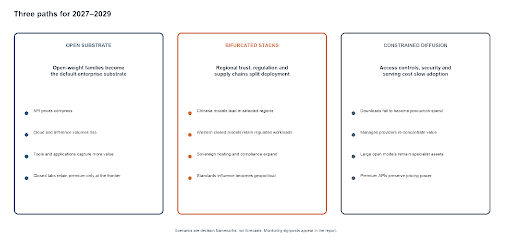
Source: Solten & Co. scenario framework. Not a forecast.

In the open-substrate scenario, enterprises treat models as interchangeable components. Open families become default starting points; premium closed models are invoked only when incremental capability justifies cost. Model API prices compress, but inference volumes expand. Full-stack clouds, efficient hardware, deployment tooling and well-distributed applications capture the value.

In the bifurcated-stacks scenario, trust, regulation and supply chains separate markets. Chinese open models dominate parts of Asia, the Global South and private deployment; Western closed models retain regulated and high-trust workloads in the United States and allied markets. Sovereign hosting, localisation and compliance become larger profit pools. Standards split rather than converge.

In the constrained-diffusion scenario, large open models remain influential research and specialist assets but do not become the default production substrate. Serving cost, security reviews and access controls slow adoption. Managed inference reconcentrates demand, and closed frontier vendors preserve pricing power. The scenario is more likely if independent benchmarks show a widening capability gap or if official restrictions disrupt model availability.

13. Investor implications

For public-market investors, Alibaba is the cleanest live experiment. The relevant question is not whether Qwen wins benchmarks but whether AI-related cloud revenue, external customer growth and adjusted EBITA outpace capex and depreciation over a full cycle. The June quarter is encouraging: growth accelerated and segment profit expanded despite investment. One quarter cannot establish returns on invested capital.[17], [18]

For venture and growth investors, a model laboratory without cloud ownership needs a credible conversion surface. API revenue, enterprise subscriptions, consumer products, proprietary data or strategic distribution must fund training and serving. Downloads are a lead indicator at best. Diligence should prioritise realised price, inference contribution margin, paid conversion, retention, workload criticality, compute commitments and licence obligations.

For infrastructure investments, demand elasticity is decisive. Lower model prices can expand token volume, context length and agentic workloads, benefiting compute, memory, networking, power and cooling. It can also intensify price competition and strand inefficient capacity. Underwriting should be based on contracted utilisation, performance per watt, customer concentration and the ability to support multiple model families.

For software investors, lower inference cost is not automatically a moat. It can improve gross margin temporarily, then be competed away. Durable beneficiaries combine AI with distribution, proprietary workflow data, high switching costs or a control point such as security, evaluation or orchestration. A product whose only advantage is access to a strong model is increasingly fragile.

Diligence scorecard

Question Strong evidence Weak evidence
Is adoption commercial? Paid production spend, renewal, critical workloads Downloads, likes, launch traffic
Is pricing sustainable? Contribution margin after serving and support Low list price without cost disclosure
Is the ecosystem defensible? Derivatives plus tools, hardware and enterprise integrations A single benchmark lead
Can the company fund the cycle? Cash runway, cloud subsidy or contracted capacity Strategic valuation alone
Can customers deploy safely? Audits, governance, licence clarity, regional hosting Open weights alone
Who captures lower cost? Retained application margin or higher usage Gross-cost decline with no pricing power

14. Open questions and monitoring triggers

Open questions

  • What share of Qwen, Kimi, DeepSeek, GLM and MiniMax usage is paid production rather than evaluation or community activity?
  • What are realised API prices, inference gross margins and compute subsidies by laboratory?
  • How much of Alibaba Cloud’s AI growth is attributable to Qwen-led workloads rather than general compute demand?
  • Which open-model derivatives are used in regulated enterprise production outside China?
  • How will custom licences evolve as the largest models become more expensive to train?
  • Do Chinese open models retain capability-per-dollar leadership under independent, task-specific evaluation?
  • What security, censorship and data-governance behaviours emerge across self-hosted and managed routes?
  • Will Chinese or Western governments restrict model-weight distribution, procurement or cloud access?
  • Does community optimisation create value for the originating lab or primarily for third-party clouds and hosts?
  • At what utilisation and configuration does self-hosting beat managed inference on total cost and reliability?

Monitoring triggers

Signal Frequency Thesis strengthens if Thesis weakens if
Qwen derivatives and established downloads Monthly Growth persists beyond launch cohorts Activity decays or shifts to another family
Router token and dollar share Monthly Chinese models gain paid production spend Share is promotion-driven or transient
Alibaba AI Cloud revenue / EBITA / capex Quarterly Profit grows with utilisation Capex rises without durable margin
Official API prices Monthly Volume expands without destructive repricing Repeated cuts imply unsustainable competition
Independent capability-per-dollar Per release Open models remain adequate for enterprise tasks Closed frontier gap widens materially
Licences and weight availability Per release Commercial terms remain usable Restrictions and revenue conditions broaden
Named enterprise deployments Quarterly Renewed, regulated workloads appear Pilots fail to reach production
China / U.S. policy Event-driven Cross-border access remains open Export, procurement or hosting limits expand
Hardware and cloud integrations Monthly More optimised, multi-provider serving Availability narrows to captive stacks

15. Conclusion

China’s strongest open-weight releases are not acts of commercial surrender. They are bids to make model intelligence abundant enough that distribution, infrastructure and ecosystem position become the scarce assets. The model works most clearly for a full-stack company such as Alibaba, which can monetise compute, cloud services, chips and applications around Qwen. It is more speculative for independent laboratories that must finance frontier training while competing on API price.

The strategy matters beyond the laboratories themselves. It lowers the reservation price for adequate intelligence, weakens model exclusivity, accelerates multi-model deployment and raises the value of compute efficiency, governance, proprietary data and application distribution. It also exports architectural choices and developer habits. Those structural effects can persist even if a Chinese model never holds the absolute benchmark lead.

The correct investment stance is neither ‘open source wins’ nor ‘closed models win.’ It is to follow the conversion from reach to economics. The winning companies will be those that turn cheaper intelligence into paid throughput, durable workflows and attractive returns on capital. Downloads are evidence of movement. Revenue, retention, margin and standards are evidence of power.

Methodology and limitations

This report triangulates official model cards, licences, API price pages, listed-company disclosures, platform adoption data, policy research, academic work and high-quality reporting. Primary sources establish release facts, stated prices and company-reported metrics. Vendor benchmarks are not normalised and are not used as definitive rankings. Computed figures show formulas and boundaries. Reported policy discussions are not treated as enacted policy.

The evidence base is strongest on what was released, under which licence, at what list price, and on Alibaba’s segment results. It is weaker on private-company economics, causality between open releases and cloud revenue, production market share, enterprise security outcomes and total cost of self-hosting. Conclusions in those areas are explicitly conditional.

Sources & evidence

Evidence cut-off: 21 August 2026. Access dates are the same unless otherwise noted. Vendor benchmark and adoption claims are attributed; they are not treated as independent verification. Adjacent references are separated as [10], [11] for legibility.

  1. Qwen3.8 official release repository and release log. Source
  2. Qwen3.8-2.4T-A95B official model card and license. Source
  3. Alibaba Cloud: Qwen3.8-Max launch announcement, 3 Aug. 2026. Source
  4. Moonshot AI: Kimi K3 launch, architecture, evaluations and API pricing. Source
  5. Kimi K3 official pricing page. Source
  6. Z.ai: GLM-5.2 official release. Source
  7. Z.ai: GLM-5.3 official release. Source
  8. Z.ai developer pricing. Source
  9. DeepSeek official Hugging Face model catalogue. Source
  10. DeepSeek-V4 official collection. Source
  11. DeepSeek API models and pricing. Source
  12. MiniMax-M3 official model card. Source
  13. MiniMax-M3 community license. Source
  14. Hugging Face: State of Open Models — Summer 2026. Source
  15. ATOM Project report on open-model adoption. Source
  16. Associated Press: Chinese-model consumer and router adoption, July 2026. Source
  17. Alibaba Group June-quarter 2026 results. Source
  18. Alibaba Group June-quarter 2026 results, exchange-hosted copy. Source
  19. Alibaba Cloud: Joe Tsai on open-source monetization. Source
  20. Alibaba Cloud full-stack AI roadmap and RMB380bn investment plan. Source
  21. Alibaba Cloud Model Studio token pricing. Source
  22. OpenAI official API pricing. Source
  23. Anthropic: Claude Fable 5 availability and pricing. Source
  24. U.S.-China Economic and Security Review Commission: Two Loops. Source
  25. Stanford HAI/DigiChina: China’s diverse open-weight ecosystem. Source
  26. Reuters: reported discussions about possible Chinese restrictions on overseas access. Source
  27. China NDRC: action plan on global AI cooperation. Source
  28. ArXiv: U.S. policies and China’s open-AI ecosystem. Source
  29. ArXiv: Use of Chinese open-weight models in scientific research. Source
  30. ArXiv: Chinese open models on financial-language tasks. Source
  31. Z.ai GLM-5.2 official Hugging Face model repository. Source
  32. MiniMax investor-relations release index. Source

How to Detect Logic Leaks in Your Board Decks: The Signal Audit Approach

Most board decks fail quietly. They look professional, tell a coherent story, and get polite nods from investors – but underneath, the logic doesn’t hold. The narrative says one thing. The operational reality says another. These gaps are what I call logic leaks, and they’re expensive. By the time they surface as a missed milestone or a stalled fundraise, the damage is already done.

Logic leaks happen because founders move faster than their documentation can keep up. Over time, the story you’re telling diverges from the company you’re actually building. The vision slide promises aggressive market expansion, but the org chart shows a hiring freeze. The financial model forecasts improving margins, but those margins depend on temporary vendor discounts that expire next quarter. You’re selling an engine that your chassis can’t support.

The Signal Audit is a diagnostic approach I developed to catch these structural failures before they become irreversible. It’s not about judging the quality of individual slides – it’s about stress-testing whether the business logic they describe actually holds together.

The 5 Signals Framework
The audit is built on a system I call the 5 Signals. These aren’t performance metrics. They’re structural indicators that reveal whether your startup is internally coherent and externally credible. When the signals are aligned, decisions get easier, execution gets faster, and investors see clarity instead of risk. When they’re misaligned, friction compounds until something breaks.

Here’s what each signal measures:

Signal I: Vision
Do you and your co-founders actually agree on where you’re going? Not just in broad terms, but in the specific decisions that vision implies – who you’re building for, what you’re willing to say no to, how you define success. Weak vision signals show up as inconsistent pitches, roadmap whiplash, and teams that don’t know what they’re optimizing for.

Signal II: Value
Are you solving a problem urgent enough that someone will pay to fix it? This isn’t about features or technology – it’s about whether your solution creates a meaningful outcome for a real person with a real budget. Weak value signals look like high demo interest but low conversion, or users who churn after onboarding because they never felt the pain you thought you were solving.

Signal III: System
Can you prioritize under pressure, or are you just reacting to noise? System is about execution clarity – whether your team knows what matters most right now, whether you have mechanisms to track progress and adapt, whether you can say no to distractions that don’t align with your strategy. Weak system signals look like chronic busyness without momentum.

Signal IV: Market
Are you entering a real, reachable market with a credible wedge, or are you guessing? This isn’t about TAM size – it’s about demand, timing, competitive positioning, and whether you have a specific strategy for gaining traction. Weak market signals show up as broad targeting (”we’re building for SMBs”), vague differentiation, or customers who like your idea but never convert.

Signal V: Momentum
Are you actually moving forward in ways that matter, or just staying busy? Momentum is the external proof of your internal signals – revenue, retention, engagement, and strategic milestones. It’s what investors and customers see. Weak momentum signals look like vanity metrics, one-time spikes that don’t compound, or traction that depends on unsustainable tactics.

These signals are interconnected. A weak vision signal will degrade your system. A confused value signal will undermine your momentum. An unclear market signal will make your traction meaningless. The audit works by checking whether the signals reinforce each other or cancel each other out.

The Anatomy of a Logic Leak
Most logic leaks are signal mismatches – places where one part of your deck contradicts another. You claim your competitive advantage is proprietary technology, but your financial forecast shows 80% of capital going to customer acquisition instead of R&D. You’re betting against your own narrative.

Or you present a bold market-expansion strategy that requires specialized engineering talent, yet your org chart shows a hiring freeze. The strategy and the system are out of sync. On their own, both slides might look fine. Together, they reveal a structural contradiction.

The most dangerous leaks are efficiency mirages – situations where your metrics look good on the surface but depend on temporary conditions that won’t last. Your margins are improving, but only because of vendor discounts that expire in two quarters. Your user growth is strong, but it’s driven by a promotional campaign you can’t afford to sustain. The signal of profitability or traction is actually noise. The long-term integrity of the business is compromised for a short-term story.

Why Forensic Clarity Matters
Your board isn’t just there to support you – they’re there to mitigate risk and govern the company. When you present

a deck with undetected logic leaks, you’re not just presenting a plan. You’re signaling a lack of control over your own operational reality.

This is where the Signal Audit adds value. It provides a second set of eyes that isn’t caught up in the daily fires of the business. By the time a board deck reaches the meeting, it’s been polished to a high gloss. The audit strips that gloss away to check whether the logic underneath is sound.

The goal is to move from unconscious risk – where you don’t know what you don’t know – to informed decision-making. Once a leak is identified, you can patch it. You can adjust the hiring plan, realign the budget, or pivot the narrative to match the data. But you can’t fix what you can’t see.

How the Signal Audit Works
The audit doesn’t evaluate slides in isolation – it looks for coherence across the system. Here are the checks that catch most leaks:

Signal I/II Alignment Check: Does your vision require a type of value delivery that your product or business model can’t support? If you’re positioning as a premium solution but pricing like a commodity, something’s misaligned.

Signal II/V Consistency Check: Does your claimed value proposition match what your momentum metrics actually show? If you say your strength is retention but your growth depends on constant new user acquisition, your value signal is weak.

Signal III/V Linkage Check: Is your operational system capable of producing the momentum you’re showing? If your margins are improving but your team is underwater, or if your growth is accelerating but your hiring is frozen, the system can’t sustain what the momentum suggests.

Signal IV Reality Check: Is your market strategy grounded in evidence or aspiration? If your deck shows a massive TAM but you can’t name your first 100 buyers or your wedge into the market, you’re not building on solid ground.

The audit produces a signal profile – a map of where you’re strong and where you’re leaking. That profile tells you what to fix before your next board meeting, your next fundraise, or your next major decision.

Building Systems to Catch Mistakes Early
The most successful founders aren’t the ones who never make mistakes – they’re the ones who build systems to catch mistakes before they compound. Detecting logic leaks is one of those systems.

It’s not about perfection. It’s about knowing where your story has drifted from the facts, and closing that gap before it costs you a round, a hire, or a year of momentum.

If you can’t see the cracks in your own logic, you’re not looking closely enough. The Signal Audit is how you start looking.

Most irreversible decisions don’t look risky when they’re made

Most irreversible decisions don’t announce themselves as dangerous.

They usually arrive quietly. The data looks solid. The plan feels coherent. The alternatives seem weaker. People around the table agree. Time appears to be moving forward, not closing in.

Nothing looks broken yet. Metrics hold. Teams function. Customers don’t notice anything. On the surface, the system feels intact — sometimes even healthy.

That’s precisely what makes these decisions hard to see.

The real risk isn’t visible because it doesn’t live in outcomes yet. It lives in commitment.

Irreversible decisions are rarely about a single bold move. They’re about crossing a line after which changing course becomes expensive — structurally, socially, or politically. The cost isn’t immediate. It accumulates quietly, while everything still appears manageable.

Scaling is one example. Growth itself isn’t the danger. What locks in is a set of assumptions: about demand, coordination, incentives, and execution. Once headcount doubles and dependencies form, questioning those assumptions becomes difficult. Not because they’re correct, but because too much now depends on them being correct.

Key hires work the same way. Especially senior ones. On paper, the role makes sense. The résumé is strong. The need feels urgent. What often goes unexamined is how much organizational shape forms around that hire. Reporting lines, informal power, decision rights. After a short time, reversing the hire is no longer a simple personnel decision. It becomes a system change.

Capital introduces another layer. Money creates options, but it also creates obligations. Growth targets. Timelines. External expectations. Once capital is taken, certain paths quietly close. Freedom remains in theory, but in practice the company now moves within a narrower corridor.

What makes these moments particularly deceptive is that they often occur during periods of apparent clarity. The narrative sounds right. The spreadsheets reconcile. The logic flows. Disagreement fades — not necessarily because the decision is sound, but because challenging it feels inconvenient, untimely, or disruptive.

Consensus tends to arrive not when risk has been resolved, but when questioning becomes uncomfortable.

By the time consequences surface, the decision itself is no longer under review. Attention shifts to execution. To managing symptoms. To dealing with second-order effects. People begin to wonder why things feel heavier, slower, and more fragile than expected.

In most cases, the answer is simple and frustrating. The problem wasn’t execution. It was what never received enough scrutiny before the commitment.

Most failures don’t come from missing information. They come from untested assumptions — things everyone loosely agreed on without ever pressing on whether they were true, necessary, or even relevant.

Reversibility doesn’t disappear all at once. It erodes. With each step that feels minor. With each commitment that seems temporary. Until one day, turning back is no longer realistic, even if something clearly feels off.

By then, momentum takes over. And momentum is often mistaken for inevitability.

The real work happens earlier than most people expect. Before urgency peaks. Before alignment hardens. Before the decision begins to feel like the only logical next step.

That is usually the last moment when risk is still visible — if someone is willing to look for it.

When progress becomes the most dangerous illusion

In many organizations, progress is treated as an unquestioned good. Things are moving. Decisions are being made. Work is visible. Teams are busy, roadmaps are full, and metrics show activity. Even when outcomes are uncertain, progress itself provides reassurance. It creates the feeling that the company is alive and advancing. That feeling, however, is exactly what makes progress dangerous.

I’ve seen companies fail not because they stalled, but because they never stopped moving. They hired, shipped, expanded, optimized, and raised capital. From the outside, everything appeared healthy. Internally, clarity slowly eroded. The organization became increasingly active while drifting further from understanding what actually mattered. Progress replaced judgment.

The illusion begins when motion is mistaken for direction. As long as work continues along a plan, the plan itself stops being questioned. Execution takes precedence, while the assumptions beneath it fade into the background. Questions that might slow things down are postponed. Doubts are reframed as resistance. Momentum becomes something to protect, even when no one can clearly explain where it is leading.

One reason this illusion persists is that progress is measurable, while correctness is not. Velocity is easy to track. Validity is not. You can count releases, hires, revenue milestones, and usage metrics. You cannot easily measure whether the underlying logic still holds, whether today’s gains are strengthening the system or quietly narrowing future options.

Progress also aligns people socially. It creates shared effort and reduces friction. Challenging it feels disruptive. It risks reopening decisions that were already agreed upon or slowing a group that values speed. Over time, organizations develop a strong bias against stopping to reassess. The faster they move, the harder it becomes to pause.

This is where progress turns from a signal into a shield. As long as things are moving, decisions are protected from scrutiny. Activity becomes evidence of correctness. Those who raise structural concerns often appear abstract or negative, even when they are pointing at real risk. The system rewards action, not reflection.

The most dangerous form of progress I’ve encountered is incremental improvement built on a flawed premise. Each step makes sense locally. Each optimization appears rational. But collectively, they deepen commitment to a direction that should have been questioned earlier. By the time the mismatch becomes visible, too much has already been invested to change course easily.

At that stage, progress becomes self-reinforcing. More resources are allocated to justify prior decisions. Complexity increases to compensate for unresolved tensions. Leaders spend more time managing symptoms than revisiting causes. The organization grows busier, more sophisticated, and more constrained at the same time.

What’s usually missing is not effort or intelligence, but pause. A deliberate interruption of motion long enough to examine assumptions that have become implicit. Which decisions have quietly turned irreversible? Where is execution being optimized instead of direction being validated? What are we no longer willing to question?

Real progress is not defined by constant movement. It is defined by the ability to change one’s mind before change becomes prohibitively expensive. That requires restraint, not just ambition. It requires distinguishing between momentum that compounds flexibility and momentum that quietly eliminates it.

The paradox is that slowing down at the right moment is often the fastest way to avoid long-term damage. Yet in environments that celebrate speed and decisiveness, this pause feels counterintuitive. As a result, many organizations accelerate directly into constraints they could have avoided.

When progress is no longer examined, it stops being a sign of health and becomes a mask. Behind it, misalignment grows unnoticed, reinforced by habit and protected by activity. By the time the illusion breaks, reversal is no longer cheap.

That is why progress, when left unquestioned, can become the most dangerous illusion of all.

The real risk is rarely the decision you’re arguing about

In many companies, the most attention goes to the visible decision — a major hire, a funding round, a pivot, or an acquisition. These moments trigger debate, analysis, and strong opinions.

But the real risk often sits elsewhere.

It accumulates quietly in small, seemingly harmless decisions: temporary structures that become permanent, roles that expand without clarity, incentives that drift, shortcuts that harden into process. None of these choices feel strategic on their own. Together, they reshape the system.

By the time a “big” decision arrives, the outcome is often already constrained. The system has lost flexibility long before anyone names it.

This is why many failures aren’t caused by choosing the wrong option at a critical moment. They come from a pattern of unexamined decisions that slowly remove room to maneuver.

The most important signals are often found in what teams no longer question — assumptions that feel too obvious to revisit, or choices that are treated as settled without anyone remembering when they were made.

That’s where decision risk usually lives. Not in the argument everyone is having, but in the structure that defines which options still exist.

Why Companies Rarely Fail From One Bad Decision

The postmortem narrative is always the same. A company misses expectations, loses momentum, struggles operationally, and eventually fails. The search begins immediately for the pivotal moment when everything went wrong. Someone points to a product launch. Someone else blames an acquisition, a hiring decision, a fundraising round, or a market expansion. Everyone agrees: if we can identify one bad decision, we can understand what happened and avoid repeating it.

The appeal is obvious. Human beings prefer simple stories. A single catastrophic decision provides clean causality. It gives us the illusion that success and failure are determined by a handful of pivotal moments. More importantly, it lets us believe that if we identify the mistake, we can prevent the disaster.

The problem is that most companies do not actually fail this way.

In reality, businesses rarely collapse because of one bad decision. They deteriorate because a series of apparently reasonable decisions are made on top of conditions that leadership does not fully understand. Weak assumptions remain unchallenged. Operational friction accumulates silently. Complexity grows faster than visibility. Small contradictions emerge between how the business appears to perform and how it actually operates. The organization continues moving forward, often successfully, until one day a highly visible event exposes problems that have been developing for years.

The final decision receives the blame because it is visible. The structural conditions that made the outcome inevitable are much harder to see.

Consider how companies explain failed expansions. Leadership concludes they entered a market too early or expanded too aggressively. While that explanation may contain some truth, it rarely touches the real issue. The expansion itself was often not the problem. The deeper issue was weak unit economics, unclear retention patterns, operational dependence on key individuals, or a business model that had not yet proven repeatable scalability. The expansion simply exposed logic leaks that already existed.

The same pattern emerges with senior hiring failures. When an executive underperforms, organizations blame the hire. But many leadership failures occur because the company lacked the operational clarity, accountability structures, reporting systems, or organizational maturity required for the role to function. The individual becomes the visible explanation for a deeper structural problem—one that the company was not ready to address.

What makes these situations particularly dangerous is that growth creates camouflage for underlying fragility.

Businesses tend to look healthiest at precisely the moment when leadership should be asking the most difficult questions. Revenue is increasing. New customers are arriving. Headcount is growing. Investors are showing interest. From the outside, the company appears to be succeeding. Under those conditions, few people feel pressure to investigate whether the underlying business is actually becoming stronger or whether it is simply moving faster.

Growth obscures logic leaks remarkably well. Strong customer acquisition can temporarily hide weak retention. Rising revenue can disguise deteriorating margins. Founder involvement can compensate for operational inefficiencies that would otherwise become obvious. Manual workarounds can keep systems functioning long enough to avoid immediate consequences. The business continues producing acceptable results, which creates the impression that the underlying structure is sound.

The weakness has not disappeared. It simply has not yet become expensive enough to demand attention.

This is why business problems are routinely misdiagnosed. Leaders naturally focus on visible outcomes because visible outcomes are easier to measure. They see slowing growth, declining profitability, missed targets, or operational bottlenecks. What they often miss is that these are symptoms, not causes. The real issues develop gradually, often invisibly.

A reporting process becomes slightly less reliable. A team creates a workaround because fixing the underlying system seems inconvenient. Customer complaints increase marginally but remain manageable. Decision-making becomes more centralized because leadership does not fully trust the organization to operate without constant oversight. None of these developments appears significant in isolation. Most seem entirely rational at the time.

The danger lies in their accumulation.

Organizations are remarkably capable of adapting to small inefficiencies. They compensate, improvise, and continue moving forward. The problem is that adaptation can easily be mistaken for health. Over time, the business becomes increasingly dependent on temporary solutions, undocumented knowledge, manual intervention, and founder heroics. Operational leverage weakens. Complexity grows. Visibility declines. Yet because the decline is gradual, few people recognize how much the underlying structure has changed.

This becomes even harder to reverse once momentum enters the system.

As companies grow, decisions become embedded in forecasts, hiring plans, investor expectations, operating procedures, and organizational structures. Re-examining those decisions becomes structurally expensive. Leaders become emotionally invested in strategies they created. Teams become politically invested in initiatives they launched. Investors become financially invested in the assumptions that support growth narratives.

At that point, questioning the direction often feels riskier than maintaining it.

This is why organizations frequently defend decisions that deserve closer examination—not because leadership is irrational, but because the cost of changing course appears higher than the cost of continuing forward. Momentum, however, does not eliminate underlying weaknesses. It simply allows them to continue compounding beneath the surface.

Eventually, the business reaches a point where accumulated contradictions become impossible to ignore. Growth slows. Margins compress. Execution quality deteriorates. Customers become harder to retain. Founders become overwhelmed. Investors begin asking difficult questions. What appears to be a sudden decline is usually the result of conditions that have existed for years.

The visible event may feel sudden. The underlying process rarely is.

This is why investigations into business performance should begin with a different question. Instead of asking which decision caused the failure, leaders should ask what structural conditions made that decision dangerous in the first place.

That shift changes the entire analysis.

Instead of focusing on a single event, attention moves toward systems, incentives, assumptions, operational realities, and how decisions compound. Instead of searching for a mistake, leadership begins searching for accumulated operational debt. Instead of blaming one decision, the investigation explores the environment that produced it.

That is usually where the real explanation exists.

Companies rarely fail because of one bad decision. They fail because logic leaks, operational friction, flawed assumptions, and structural contradictions are allowed to compound unchecked. The final decision may become the story everyone remembers, but it is rarely the story that matters most.

The more useful question is not which decision caused the problem.

The more useful question is: what did the organization stop seeing long before the consequences became visible enough to demand action?

Why Smart Leaders Defend Bad Decisions

The problem is rarely irrational leadership. More often, leaders defend decisions that once made sense, even after reality has started changing beneath them.

One of the most persistent myths in business is that expensive failures happen because leaders make obviously bad decisions. This belief is comforting because it creates distance. It allows people to look at failed companies, broken growth stories, or expensive strategic mistakes and assume the warning signs must have been obvious to anyone paying attention. In hindsight, it often appears that leadership simply ignored reality, acted emotionally, or failed to think clearly.

Real business life is usually more complicated than that.

Most expensive mistakes do not begin as reckless decisions. They begin as decisions that looked rational in the moment. The company had grown. The market looked promising. Investors were supportive. Hiring seemed necessary. Expansion felt logical. Capital was available. Momentum appeared to validate the direction. Leadership teams often had reasons—sometimes very good reasons—for doing what they did.

This is what makes bad decisions dangerous. They rarely announce themselves as mistakes. They often arrive wearing the appearance of logic, responsibility, and progress.

Leadership teams never operate with perfect visibility. Even sophisticated companies make major decisions with incomplete operational truth. Founders see reports, dashboards, forecasts, board feedback, team narratives, customer signals, and financial models, but no leadership team sees the business in its entirety at any given moment. Operational friction may be hidden beneath headline growth. Reporting may simplify reality. Teams may filter bad news. Internal systems may lag behind external momentum. What looks like a clean strategic picture is often a partial representation of a much messier operating reality.

This gap matters because decisions are made inside narratives, not inside omniscient reality.

A company may appear to be growing while margins quietly deteriorate. Revenue may improve while customer quality weakens. Hiring may accelerate while operational coordination becomes more fragile. Pipeline growth may look healthy while retention quietly declines. Investors may celebrate surface progress while the company underneath becomes increasingly difficult to manage. Leadership teams often make decisions based on what appears visible and coherent, even when important contradictions remain hidden beneath the surface.

The second problem is that decisions do not remain abstract. Once a company commits to a strategic direction, that decision becomes embedded in the identity of the business. Founders announce it. Investors support it. Teams organize around it. Hiring plans reflect it. budgets assume it. Internal reporting starts measuring it. Language changes around it. A strategic move that began as a choice slowly becomes part of how the organization understands itself.

At that point, reversing course becomes psychologically and operationally difficult.

Many people describe this as ego, but that explanation is too shallow. The issue is not simply that leaders become personally attached to their ideas. The deeper problem is that unwinding a decision often forces leadership to confront the cost of admitting that reality is no longer matching the assumptions that justified the original move. That may mean slowing growth, reducing spending, changing leadership, rewriting forecasts, disappointing investors, abandoning a product initiative, or publicly acknowledging that a strategic assumption is no longer working.

That is rarely a painless process.

Momentum makes this problem worse. One of the most deceptive forces in business is early success. Surface indicators often reinforce decisions long before the deeper economics of the business have fully matured. Revenue growth creates confidence. Hiring creates confidence. Market attention creates confidence. Fundraising creates confidence. Customer demand creates confidence. The business appears to be moving in the right direction, and each visible sign of progress reduces the incentive to question the assumptions underneath.

This is where weak decisions often become dangerous.

A company may be scaling sales while operational capacity quietly weakens. A team may be hiring aggressively while internal ownership remains unclear. A product may attract customers while retention economics deteriorate. A company may raise capital and assume the business is stronger than it actually is. Surface momentum creates the impression that the strategy is working, even when the underlying system is becoming more fragile.

This is one of the reasons smart leaders often defend bad decisions longer than outsiders expect. From inside the business, the evidence may not look irrational. It may look mixed, incomplete, or temporarily explainable. Teams often create narratives that justify waiting. A bad quarter becomes a timing issue. Weak retention becomes a temporary onboarding problem. Margin pressure becomes a scale issue that will improve later. Operational friction becomes “growing pains.” Founders tell themselves the next milestone will fix what the current complexity has exposed.

Sometimes it does.

Often it does not.

As organizations grow, challenging the original decision also becomes harder for structural reasons. Teams align around the current plan. Reporting begins supporting existing priorities. Dissent becomes politically expensive. Senior hires are incentivized to execute, not destabilize. Boards often discuss visible metrics, not invisible contradictions. Employees interpret leadership confidence as confirmation that the strategic direction remains valid.

Over time, the organization begins protecting the decision itself.

This is where leadership can become trapped inside its own internal logic. The original assumptions may no longer be true, but too many systems now depend on continuing forward. Admitting reality creates immediate pain. Continuing forward delays that pain. Many leadership teams choose to delay because delay feels less disruptive in the short term, even when it increases long-term cost.

This is why one of the most useful questions in business is also one of the least frequently asked:

What would have to be true for this decision to no longer make sense?

This question changes the nature of leadership thinking because it forces a team to examine the assumptions beneath the decision instead of defending the decision itself. It introduces conditional thinking where certainty may have become dangerous. It forces leaders to identify which signals would invalidate the current strategy, which metrics matter more than narrative, and what hidden contradictions may be growing beneath visible progress.

Without this kind of pressure-testing, many companies continue defending decisions simply because reversing them feels harder than continuing.

This is also why external judgment becomes valuable in high-consequence situations. Leadership teams are often too close to their own narratives to see structural contradictions clearly. This does not mean leaders are unintelligent. In many cases, it means they are deeply embedded in a system whose internal logic now protects momentum more effectively than it protects truth.

An outside review does not guarantee better decisions, but it often restores a form of skepticism that internal momentum gradually erodes. It helps leadership examine assumptions, surface contradictions, and ask questions that become difficult to raise once too much organizational energy has been invested in a direction.

The danger in business is rarely irrational leadership.

The real danger is more subtle.

It is rational people defending decisions that once made sense, even after the conditions that supported those decisions have started changing.

By the time reality becomes obvious, optionality is often smaller, the cost of correction is significantly higher, and what once looked like progress is now an expensive structural problem that leadership can no longer ignore.

The Most Expensive Decisions Rarely Look Wrong at the Time

Why intelligent leadership teams make costly decisions with incomplete visibility—and why those decisions often feel rational until the consequences arrive.

When companies fail, people often rewrite the story in a way that makes failure appear far more predictable than it actually was.

Once a business begins struggling, observers tend to simplify what happened into a clean narrative with a clear point of failure. The company hired the wrong executive. It expanded too early. It raised too much capital. It launched too many products. It entered the wrong market. In hindsight, the mistake suddenly appears obvious.

Investors do this in private conversations. Founders do it in postmortems. Employees do it when trying to explain why things unraveled. Clear explanations are emotionally satisfying because they create the illusion that failure was easy to identify.

In reality, most expensive business mistakes do not look reckless when they are being made.

They usually look rational.

A founder experiencing strong growth may hire senior executives because operational pressure is increasing and investors expect maturity. A company may raise capital because competitors are moving aggressively and market demand appears strong. Leadership may expand into new markets because early traction suggests a larger opportunity. Product teams may launch adjacent offerings because customers appear interested.

These decisions rarely feel irresponsible in real time. In many cases, they feel like exactly what serious companies are supposed to do next.

That is what makes them dangerous.

Most expensive mistakes are not usually caused by irrational leadership. They are often made by highly capable founders, executives, and investors operating with incomplete visibility into the true condition of the business.

As companies grow, leadership naturally becomes more removed from operational reality. Founders stop seeing daily friction firsthand and begin relying on dashboards, executive summaries, board updates, and department reporting. Over time, this creates a widening gap between what leadership believes is happening and what teams are experiencing on the ground.

Revenue may be increasing while customer retention quietly weakens. Hiring may appear successful while accountability becomes fragmented. Product velocity may look strong while teams rely on manual workarounds to maintain performance. Leaders begin making major decisions based on representations of reality rather than reality itself.

Growth pressure makes this worse.

Growth-stage companies are constantly encouraged to move faster. Competitors are raising capital. Investors expect acceleration. Markets reward speed. Leadership teams begin treating hesitation as weakness because slowing down feels dangerous when everyone around them appears to be moving quickly.

Urgency gradually replaces disciplined thinking.

Success creates another distortion. When a company starts winning, leadership often becomes less skeptical of its own assumptions. Revenue growth creates confidence. Investor validation creates confidence. Market attention creates confidence. None of these signals are inherently bad, but they often reduce the willingness to challenge assumptions that may no longer be true.

Companies also become trapped inside their own narratives.

Every business develops stories about itself. Some believe they are operationally disciplined because growth has been strong. Others believe product-market fit is stronger than it actually is. Some assume they are fundamentally better operators than competitors because momentum appears to validate that belief.

These narratives help companies attract talent and capital. They become dangerous when leadership starts protecting the story instead of examining reality.

This problem becomes even worse because companies tend to overvalue visible growth signals while ignoring structural health signals.

Revenue growth is often interpreted as proof that the business is becoming stronger, even though revenue frequently measures demand more effectively than durability. A company can grow rapidly while customer retention weakens, margins compress, and internal execution becomes increasingly fragile.

Fundraising creates a similar illusion. Founders often interpret investor interest as proof that the business is structurally stronger than it actually is. In reality, investors frequently underwrite future opportunity, market timing, and founder potential—not operational discipline.

Expansion decisions can create the same false confidence. Launching adjacent products, entering new markets, and rapidly increasing complexity often look like progress because they are visible and easy to celebrate. Investors may reward them. Employees may interpret them as ambition. The market may see them as signs of strength.

Meanwhile, the quieter signals receive far less attention.

Customer retention may be weakening. Reporting systems may be incomplete. Founders may still be acting as invisible operational glue across departments. Teams may rely on spreadsheets, undocumented workflows, and manual fixes to maintain performance. Ownership may become increasingly unclear as the organization grows.

These issues rarely appear in board presentations because they are far harder to package into a growth narrative.

This creates one of the most dangerous conditions in business: leadership becomes highly informed about visible momentum while remaining poorly informed about structural resilience.

Momentum amplifies this problem even further.

Momentum feels almost universally positive while it is happening. Revenue is increasing. Hiring accelerates. Customers are arriving faster. Partnerships expand. The company feels like it has found its trajectory.

This is often where decision quality begins to deteriorate.

As businesses move faster, leadership teams lose time for deeper evaluation. Decisions begin happening in rapid succession because maintaining speed starts feeling like a strategic obligation. More hiring decisions are approved. Larger growth targets are accepted. Product expansion moves faster. Geographic expansion feels urgent.

The problem is that speed and strength are not the same thing.

A company can move faster while becoming structurally weaker if its internal systems are not evolving at the same pace as its growth.

Success can also reduce skepticism. Employees become less willing to challenge assumptions because leadership appears confident. Investors may ask fewer difficult questions because growth metrics remain attractive. Boards often encourage acceleration because momentum looks like validation.

External success can quietly eliminate internal skepticism at exactly the moment stronger scrutiny is needed.

This is why leadership teams need better questions before making major commitments.

Most companies ask whether the opportunity is large enough, whether competitors are moving faster, whether investors will support the decision, or whether timing feels right.

Those questions are incomplete.

A far better question is this:

What hidden problem becomes significantly more expensive if this decision succeeds?

That question changes how leadership evaluates growth.

A company scaling sales should ask whether onboarding systems can absorb a larger volume. A company raising capital should ask whether additional capital will strengthen discipline or amplify inefficiency. A company hiring executives should ask whether the organization is structured well enough for those leaders to succeed. A company entering new markets should ask whether the original business is actually stable enough to expand.

This question shifts attention away from visible opportunity and toward hidden fragility.

That shift becomes even more important because leadership teams rarely operate from a neutral position.

Founders, executives, and investors are emotionally invested in outcomes. They are financially tied to decisions. They are often deeply connected to the narratives that helped build momentum in the first place.

Over time, proximity becomes a serious risk.

Leadership teams become highly effective at solving immediate problems while becoming less effective at questioning foundational assumptions. Operational friction gets dismissed as temporary growing pains. Failed hires get blamed on individuals instead of organizational design. Rising complexity gets interpreted as proof of scale.

This is why organizations need mechanisms that challenge internal thinking before major commitments are made. Sometimes that comes from stronger boards. Sometimes from experienced operators. Sometimes from independent advisors. The specific mechanism matters less than the discipline of introducing objective pressure before irreversible decisions are made.

The business world tends to celebrate decisiveness. Founders are told to move faster, trust their instincts, and outpace competitors. Investors often reward aggressive growth narratives. Markets tend to favor companies that project confidence.

That environment creates a dangerous misunderstanding about how companies actually fail.

Most expensive mistakes do not begin with obviously irrational decisions.

They begin with decisions that appear entirely reasonable.

That is precisely why they become so expensive.

By the time underlying weaknesses become obvious, headcount has already expanded, capital has already been deployed, expectations have already been set, and strategic commitments have already been made.

Optionality disappears precisely when leadership needs it most.

Why companies rarely fail from one bad decision

Founders often describe failure as a single event.

They hired the wrong executive. They raised at the wrong valuation. They expanded too early. They spent too aggressively. They entered the wrong market. These explanations are clear and emotionally satisfying because they reduce a complicated decline into one visible moment where things supposedly went wrong.

That version is rarely accurate.

In most cases, the visible decision is simply the moment when existing structural problems become impossible to hide. The actual failure usually begins much earlier, when leadership teams make reasonable decisions without seeing the operational weaknesses sitting underneath the business.

That distinction matters because it changes how companies should evaluate growth decisions.

A company may decide to scale aggressively because revenue is growing quickly. On paper, that decision looks rational. But if reporting systems are weak, customer retention is declining, operational accountability is unclear, or margins are quietly deteriorating, growth can magnify those weaknesses faster than leadership can react.

The same pattern appears in fundraising. Founders often assume capital will solve execution problems by creating more capacity. In reality, capital often accelerates existing inefficiencies. More hiring, more tools, and more expansion can create the appearance of progress while making the underlying business harder to manage.

I’ve seen variations of this pattern for most of my career.

Long before I worked with founders and investors, I built businesses in telecommunications infrastructure, security systems, and early internet services. These were environments where small operational mistakes created immediate consequences. If a communication network failed, customers noticed immediately. If a security system failed, there was no room for theoretical discussions about process optimization. Problems surfaced quickly because the systems were under constant stress.

That experience taught me something that applies directly to startups today: systems rarely collapse because of one dramatic event. They usually fail because small weaknesses accumulate quietly until scale exposes them.

Startups are particularly vulnerable because modern markets reward visible momentum. Revenue growth attracts attention. Fundraising announcements create external validation. Headcount growth can make companies appear stronger than they are. Product launches create momentum narratives that investors and media are eager to repeat.

None of those signals are meaningless. The problem is that they can distract leadership teams from less visible indicators that matter more over the long term.

A company may be growing quickly while internal execution becomes increasingly fragile. Leadership teams may be making strategic decisions based on dashboards that look clean but fail to reflect operational reality. Departments may appear productive while accountability becomes weaker. New executives may be hired before foundational operational problems are resolved.

The business continues moving forward, but leadership gradually loses visibility into what is actually happening beneath the surface.

This is where decision quality becomes far more important than speed.

Founders are often encouraged to move quickly because hesitation is framed as weakness. In some situations, that is true. Slow decision-making can absolutely hurt a company. But speed becomes dangerous when leadership teams are accelerating decisions without understanding what existing weaknesses become more expensive after growth.

That is the question more companies should ask before major commitments are made.

What operational weaknesses become harder to fix if this decision works exactly as planned?

That question tends to create better conversations than most strategic frameworks. It forces leadership teams to examine whether growth is exposing strength or simply masking fragility.

Before raising more capital, expanding internationally, hiring senior executives, launching new product lines, or restructuring teams, companies need a clearer understanding of what they are actually scaling.

This is one of the reasons I built Northline.

The work is not about replacing leadership judgment. It is not traditional consulting. It is not ongoing coaching.

The role is much narrower and more practical.

Northline helps founders and investors pressure-test high-stakes decisions before they become expensive mistakes. The goal is to identify structural risks early enough that leaders still have flexibility to address them.

That may mean confirming a decision should move forward quickly. It may mean slowing down an expansion plan. It may mean identifying operational weaknesses that leadership underestimated. The answer varies, but the principle stays the same.

The earlier structural problems become visible, the more options leadership teams usually have.

Most companies do not fail because of one bad decision.

They fail because leadership continues making increasingly expensive decisions without full visibility into the structure underneath them.

By the time the problem becomes obvious to everyone, the business usually has fewer options, less flexibility, and much higher consequences.

That is when ordinary mistakes become very expensive ones.

The Physics of Failure: Mapping Logic Drift in High-Growth Ventures

In the lifecycle of a venture-backed startup, the most dangerous threat to valuation is not market competition or capital shortage; it is the silent, incremental erosion of execution known as Logic Drift.

Logic Drift is the measurable delta between a founder’s strategic intent and the organization’s operational reality. In the early days of a company, the signal-to-noise ratio is near perfect because the founder is the primary operator. However, as the company scales and layers of human abstraction are added, the “Strategic Signal” begins to degrade. By the time a startup reaches Series B, the original business logic often becomes so distorted by departmental silos and “heroic” workarounds that the company is no longer running on its original operating system. It is running on a series of disconnected, often contradictory, improvised patches.

At Board.tech, we analyze Logic Drift as a form of mechanical loss. Just as an engine loses efficiency through friction and heat, a business loses margin through the friction of misaligned logic. This drift manifests as “Entropy Creep”—where hiring more people actually slows down the lead-to-cash cycle and increases operational noise. Founders often misdiagnose this as a culture problem or a talent issue, but it is almost always a structural architecture failure. The business logic that worked for ten people is being forced to carry the weight of one hundred, and the structure is buckling under the pressure.

Detecting Logic Drift requires a move away from subjective management reporting and toward a clinical, structural audit. We look for the operational debt buried in broken workflows and data silos that no longer serve the strategic goal. To eliminate drift, a founder must re-engineer the Managed Operational Layer, creating a rigid framework that preserves the integrity of the business logic regardless of how many people are added to the system.

Scaling a business is not an act of willpower; it is an act of engineering. When you eliminate Logic Drift, you aren’t just improving efficiency—you are restoring the fundamental physics of the business, ensuring that every dollar of capital is converted into a predictable and scalable result.