Skip to content

Vitaly Solten

Independent decision advisory for founders and investors

  • Work
  • Forensic Review
  • Insights
  • About
  • Request Review

Tag: organizations

Most irreversible decisions don’t look risky when they’re made

Most irreversible decisions don’t announce themselves as dangerous.

They usually arrive quietly. The data looks solid. The plan feels coherent. The alternatives seem weaker. People around the table agree. Time appears to be moving forward, not closing in.

Nothing looks broken yet. Metrics hold. Teams function. Customers don’t notice anything. On the surface, the system feels intact — sometimes even healthy.

That’s precisely what makes these decisions hard to see.

The real risk isn’t visible because it doesn’t live in outcomes yet. It lives in commitment.

Irreversible decisions are rarely about a single bold move. They’re about crossing a line after which changing course becomes expensive — structurally, socially, or politically. The cost isn’t immediate. It accumulates quietly, while everything still appears manageable.

Scaling is one example. Growth itself isn’t the danger. What locks in is a set of assumptions: about demand, coordination, incentives, and execution. Once headcount doubles and dependencies form, questioning those assumptions becomes difficult. Not because they’re correct, but because too much now depends on them being correct.

Key hires work the same way. Especially senior ones. On paper, the role makes sense. The résumé is strong. The need feels urgent. What often goes unexamined is how much organizational shape forms around that hire. Reporting lines, informal power, decision rights. After a short time, reversing the hire is no longer a simple personnel decision. It becomes a system change.

Capital introduces another layer. Money creates options, but it also creates obligations. Growth targets. Timelines. External expectations. Once capital is taken, certain paths quietly close. Freedom remains in theory, but in practice the company now moves within a narrower corridor.

What makes these moments particularly deceptive is that they often occur during periods of apparent clarity. The narrative sounds right. The spreadsheets reconcile. The logic flows. Disagreement fades — not necessarily because the decision is sound, but because challenging it feels inconvenient, untimely, or disruptive.

Consensus tends to arrive not when risk has been resolved, but when questioning becomes uncomfortable.

By the time consequences surface, the decision itself is no longer under review. Attention shifts to execution. To managing symptoms. To dealing with second-order effects. People begin to wonder why things feel heavier, slower, and more fragile than expected.

In most cases, the answer is simple and frustrating. The problem wasn’t execution. It was what never received enough scrutiny before the commitment.

Most failures don’t come from missing information. They come from untested assumptions — things everyone loosely agreed on without ever pressing on whether they were true, necessary, or even relevant.

Reversibility doesn’t disappear all at once. It erodes. With each step that feels minor. With each commitment that seems temporary. Until one day, turning back is no longer realistic, even if something clearly feels off.

By then, momentum takes over. And momentum is often mistaken for inevitability.

The real work happens earlier than most people expect. Before urgency peaks. Before alignment hardens. Before the decision begins to feel like the only logical next step.

That is usually the last moment when risk is still visible — if someone is willing to look for it.

Author adminPosted on January 20, 2026January 20, 2026Tags decisions, judgment, organizations, risk, uncertainty

When reasonable decisions quietly turn expensive

In hindsight, most strategic failures look obvious. From the outside, they appear naïve, rushed, or poorly thought through. But from the inside, at the moment they were made, they usually felt reasonable.

That is what makes them difficult to spot in real time.

In my experience, the most costly mistakes in business rarely arrive as bold gambles or reckless moves. They come disguised as sensible decisions, supported by data, framed by logic, and reinforced by internal agreement. The plan looks coherent. The numbers line up. Nothing immediately triggers an alarm.

And yet, something is often missing.

Right before certain decisions — scaling the organization, making a senior hire, raising capital, acquiring another company, or committing to a major strategic shift — the quality of conversation inside a team tends to change. Questions soften. Assumptions become implicit rather than examined. Doubts are acknowledged, but rarely pursued.

Speed starts to feel like progress.

What’s notable is that these moments are rarely driven by a lack of information. More often, the opposite is true. There is an abundance of data, projections, benchmarks, and narratives. The challenge is no longer gathering information, but distinguishing what actually matters from what merely looks convincing.

Teams begin to confuse internal alignment with external truth. Agreement inside the room becomes a proxy for validity in the market. The logic holds, but only within the boundaries of assumptions that remain unchallenged.

By the time reality intervenes, the decision has usually hardened into commitments — headcount, burn rate, contracts, expectations. At that point, revisiting the original logic feels like retreat or failure, rather than judgment. Execution is expected to compensate for what was never fully tested.

It rarely does.

What makes these situations particularly dangerous is how unremarkable they feel while unfolding. There is no visible crisis. No urgency. Just a steady sequence of reasonable steps taken without enough friction, without an external perspective, and without someone whose role is not to agree, but to slow the decision down long enough to see what is actually happening.

Only later, when consequences accumulate, does the gap become visible — the gap between how a decision felt when it was made and how it looks once its outcomes are irreversible.

That gap is where most strategic risk lives.

And it is also where many organizations underestimate how fragile even the most reasonable logic can be when it has not been meaningfully challenged.

Author adminPosted on January 7, 2026January 20, 2026Tags decisions, judgment, organizations, risk, uncertainty

The real reason your business stopped growing (it’s not what you think)

Here’s what I keep hearing from business owners when growth flatlines:

“The market’s oversaturated.” “Our competitors are undercutting us.” “Everything costs more now.”

And look, I get it. Those things are real. But after working with dozens of founders who’ve hit this wall, I’ve noticed something: the external stuff is rarely what’s actually holding them back.

The real culprit? Their business has become misaligned.

I know that sounds vague, so let me explain what I mean. Your vision, your operations, your marketing, your team—somewhere along the way, these pieces stopped pointing in the same direction. It’s like watching a rowing crew where everyone’s pulling hard, but half are angled left and half are angled right. Lots of effort. Very little forward movement.

What Misalignment Actually Looks Like

The tricky part is that misalignment doesn’t announce itself. There’s no flashing warning light. It just… accumulates. You start noticing small things that feel off:

Your business today looks nothing like what you originally set out to build. Your roadmap is bloated with half-finished projects. Your team keeps asking “what’s the priority?” because nobody’s really sure anymore. Your marketing promises one experience, but customers get something else entirely.

None of these feel catastrophic on their own. They just feel like business. But here’s what happens: you keep putting in the same hours, the same effort, maybe even more—and the results keep shrinking. That’s when the doubt creeps in. Maybe this is as big as we can get.

Why This Quietly Destroys Growth

When your business is out of alignment, everything becomes harder than it should be.

Your marketing campaigns underperform, and you can’t figure out why. Your operations feel like you’re constantly putting out fires. New people join the team and spend weeks just trying to understand how things work.

You’re sprinting, but you’re not actually moving. And eventually, you start blaming yourself, or the market, or bad luck—when really, it’s just that your engine isn’t firing on all cylinders.

How to Fix It (Without Burning It All Down)

Before you launch another product or hire another person or invest in another tool, you need to get your foundation back in sync.

I’ve started using a framework I call the 5 Drivers of Growth—it’s part of something bigger I’ve built called Signal OS™—but honestly, you can think of it as just five questions to ask yourself:

Vision – Are we still chasing the same goal we started with? Does it still make sense?

Value – Do our customers actually experience the benefit we think we’re delivering?

System – Are our processes helping us move faster, or are they the reason we’re stuck?

Market – Has our audience changed? Have our competitors evolved while we stayed the same?

Momentum – Are we building on wins, or are we scattered across a dozen directions?

I run through these with clients every quarter. Not as some big formal thing—just an honest conversation. And almost every time, we find at least one place where energy is leaking out. Once you see it, the fix becomes obvious.

Where AI Actually Helps (and Where It Doesn’t)

A lot of people ask me where AI fits into all this. Here’s my take: AI won’t create alignment for you. If your strategy is muddled, automation just scales the confusion.

But once you have clarity? That’s when AI becomes incredibly useful.

Customer follow-ups falling through the cracks? Automate them with smart CRM sequences. Hand-offs between team members turning into bottlenecks? Set up AI workflows that keep things moving. Marketing voice all over the place? Train a content assistant on your brand guidelines so every email, post, and page sounds like you.

The point isn’t to replace thinking—it’s to protect the clarity you’ve worked hard to create.

My Honest Take

Small businesses don’t fail because the market got tough. They stall because at some point, the internal pieces stopped working together, and nobody paused long enough to notice.

So before you chase the next big idea or blame the economy or double down on hustle—just stop for a second and ask yourself:

Is my vision still clear?
Is my value actually obvious to customers?
Are my systems helping or hurting?

If you hesitated on any of those, that’s your starting point. Not another marketing push. Not a new hire. Just getting back into alignment.

Author adminPosted on August 11, 2025December 26, 2025Tags decisions, judgment, organizations, risk, uncertainty

The 90-day growth blueprint for small businesses

If you run a small business, you already know what it’s like to be stuck in “busy mode.”

You’re working all the time, you’re doing all the right things… and yet, growth feels slower than it should.

Here’s the hard truth: Most small businesses don’t need more effort.

They need more alignment — and the right tools to turn that alignment into action.

That’s where the 90-Day Growth Blueprint comes in.

Why 90 Days?

A year feels too far away to drive urgency.

A month is too short to make lasting changes.

But 90 days? That’s long enough to build real momentum and short enough to stay focused.

With a clear plan and the right systems, you can make measurable progress in just three months.

The 4 Stages of the Blueprint

1. Audit — Find the Real Bottlenecks

We start by getting a full picture of your business:

  • Where revenue is coming from (and where it’s leaking)

  • Which processes take the most time

  • How your customers find and buy from you

  • Where AI and automation could save you hours a week

This isn’t guesswork — it’s a mix of strategic review, quick-win analysis, and tools audit.

The goal is to find the 20% of fixes that will drive 80% of your results.

2. Plan — Align Your Growth Drivers

Once we know where the friction is, we design a clear plan around five growth drivers:

  • Vision – Are you clear on where you’re going?

  • Value – Is your offer compelling and relevant?

  • System – Do your operations support growth, or slow it down?

  • Market – Are you targeting the right customers in the right way?

  • Momentum – Do you have a clear path to compounding results?

This stage is about alignment — making sure every action, from marketing to hiring, moves you toward the same goal.

3. AI Integration — Work Smarter, Not Harder

Here’s where most “AI advice” goes wrong:

They throw random tools at you without context.

We do the opposite.

We identify the 1–3 AI-powered systems that will actually move the needle for your business — like:

  • Automated customer follow-up

  • Smart scheduling and booking

  • AI-assisted content and marketing campaigns

  • CRM workflows that trigger without you touching them

These aren’t shiny toys. They’re practical upgrades that save time, reduce costs, and improve consistency.

4. Tracking — Stay on Course

The best plan in the world is useless if you don’t track it.

We set up simple, visible metrics — revenue targets, lead counts, response times — so you know exactly what’s working.

Each week, you’ll know:

  • What moved forward

  • What’s stuck

  • Where to adjust

It’s about staying in control without drowning in spreadsheets.

What You Can Expect in 90 Days

With this blueprint, most small businesses see:

  • Faster response times to customers

  • Fewer manual tasks

  • Clearer marketing focus

  • More qualified leads

  • A team that’s less reactive and more proactive

And the biggest result?

A business that finally feels like it’s moving forward with purpose — instead of just moving.

Final Thought

Growth doesn’t happen because you work harder.

It happens because you align the right actions with the right tools… and give yourself a system that keeps you on track.

If your business is ready for its own 90-day reset, now’s the time to start.

Author adminPosted on August 11, 2025December 26, 2025Tags decisions, judgment, organizations, risk, uncertainty

Escaping the loop: why founders keep fixing the wrong problems

Startups die for many reasons. But one of the quietest killers isn’t lack of capital, poor hiring, or even product-market fit.

It’s treating symptoms instead of addressing the root.

Again and again, I see founders “solving” problems that aren’t the real issue. They patch, spin, and build their way out of discomfort — only to find themselves right back in the same spot, a few months later, but with more features, more burn, and less clarity.

This essay is about that loop — why we get stuck in it, how to spot it, and how to finally break out.

The Problem: Misdiagnosis at the Core

Most founders are fast problem-solvers. That’s part of the job.

But the speed that serves us in building can betray us in thinking.

Here’s what often happens:

  • Revenue plateaus → add a feature
  • Investor feedback is lukewarm → redo the deck
  • Team feels lost → build more process

All valid responses. But sometimes they just decorate the surface.

Because the real issue might be:

  • You’re selling a vitamin, not a painkiller.
  • Your story doesn’t connect to urgency.
  • Your team isn’t misaligned — they’re confused because you are.

The truth? Founders often optimize the wrong layer. They fix the outputs without questioning the inputs.

That’s why six months of “doing” can result in zero net movement. It’s not for lack of effort. It’s because the work was misdirected.

Why This Happens

Two reasons:

  1. We’re too close to see it.

    Inside the business, everything feels urgent. The fire closest to your face always feels like the most dangerous. And when you’re in motion, it feels like you’re making progress.

  2. We mistake noise for signals.

    A sharp email, a drop in conversion, a confusing investor comment — they feel like data, but without context, they’re just noise. When we react to every bump, we end up in a zig-zag pattern that never compounds.

The Real Work: Diagnostic Thinking

Instead of immediately asking, “How do I fix this?”

Start with: “What’s really happening here?”

Try this mental model I call the Signal Cascade:

  • Surface-level symptom: What’s broken right now?
  • System-level failure: What internal process or decision led to it?
  • Signal-level insight: What fundamental misalignment created that decision?

Example:

Symptom → “Customers are churning after 2 months.”

System failure → “We promised a use case we can’t deliver well.”

Signal insight → “Our value prop is aspirational, but not grounded in real pain.”

Suddenly, the fix isn’t “add a retention campaign.”

It’s: “Rebuild the promise to match the reality.”

That shift saves quarters. Sometimes even the company.

How to Build This Into Your Practice

Here’s how to apply this today:

  1. Create space to reflect.

    No founder solves root issues during back-to-back Zoom calls. Block time weekly to review: what’s really going on?

  2. Use simple postmortems.

    Pick one recent failure (or friction). Ask:

    • What did we see?
    • What did we assume?
    • What was missing?
  3. Get outside perspective.

    An investor, advisor, or mentor with pattern recognition can help spot signal gaps you’re too close to see.

  4. Reframe your dashboard.

    Don’t just track KPIs. Track decisions and their outcomes. The better your feedback loop, the sharper your diagnosis becomes.

Conclusion

Your job as a founder isn’t to fix everything fast.

It’s to make sure you’re fixing the right thing in the right layer.

Because scale doesn’t just amplify success.

It also amplifies misalignment.

If something feels “off” in your company — slow down.

Zoom out. Ask better questions. Don’t just move — realign.

In a world obsessed with speed, clarity is your greatest edge.

Author adminPosted on August 4, 2025December 26, 2025Tags decisions, judgment, organizations, risk, uncertainty

The momentum trap (I used to think momentum was everything.)

The feeling of things moving, of progress being made, of opportunities multiplying faster than I could chase them. It felt like success. It looked like growth. And for a while, I convinced myself it was both.

But somewhere along the way, I realized I’d been confusing motion with progress.

The Seduction of Yes

Something is intoxicating about saying yes. That partnership opportunity that “could open doors.” The feature request from a potential big client. The investor introduction that might lead somewhere. The conference speaking slot adds credibility.

Each yes feels like momentum. Like you’re building something, moving forward, creating possibilities. But what I didn’t see at the time was what each yes was costing me.

It wasn’t just time or money, though there was plenty of both. It was focused. Clarity. The ability to see the forest for the trees, I kept planting.

The Drift

The shift happens gradually. You don’t wake up one morning with a scattered product roadmap and a confused team. It creeps in, one “strategic” decision at a time.

You added that feature because a potential customer mentioned it might be useful. You take that meeting because “you never know.” You explore that partnership because it could be “synergistic.”

Before you know it, your original vision is buried under a pile of maybes. Your team is building things they don’t quite understand for reasons that made sense three pivots ago. Your roadmap looks like a Jackson Pollock painting.

I’ve been there. We all have.

The Real Cost

What kills me about this pattern isn’t just the wasted resources. It’s the opportunity cost. While you’re chasing every shiny object, your competitors are saying no to the same distractions and doubling down on what matters.

While you’re spreading your energy across seventeen different initiatives, they’re perfecting one thing that customers actually want.

While you’re explaining to your team why this new direction makes sense, they’re executing with clarity and conviction.

The momentum you thought you were building? It was actually a drift in disguise.

Learning to Say No

The hardest lesson I’ve learned as a founder is that strategy isn’t about what you choose to do. It’s about what you choose not to do.

Every opportunity, no matter how attractive, costs something. And in the early stages of a company, when resources are scarce and focus is everything, the cost is usually higher than you think.

Saying no doesn’t feel like momentum. It feels like standing still while the world moves around you. It feels like missing out. It feels like the opposite of what a good founder should do.

But that’s where real progress lives. Not in the motion, but in the intentional stillness. Not in the expansion, but in the constraint.

The Question

I think about this a lot these days. Not as a cautionary tale, but as a lens for decision-making. When an opportunity presents itself, I try to ask not just “Could this work?” but “What am I giving up to find out?”

Sometimes the answer is worth it. Usually, it’s not.

And maybe that’s the real skill we need to develop as founders: not the ability to spot opportunities, but the discipline to ignore the ones that don’t fit.

What’s the last thing you said yes to that you now regret? And what clarity would saying no buyback today?

The momentum you’re looking for might be waiting on the other side of a well-placed no.

Author adminPosted on August 1, 2025December 26, 2025Tags decisions, judgment, organizations, risk, uncertainty

The silent trade: what you give up when you chase every opportunity

Every founder wants momentum.

We crave movement, signals of progress, things to build, people to pitch, ideas to chase. But somewhere along the way, many of us learn a hard truth:

The fastest way to stall your startup… is to chase too many paths.

It feels like growth. It looks like an opportunity. But it’s often drift in disguise.

We rarely talk about what we trade in the name of momentum:

– Strategic focus

– Mental clarity

– Team alignment

– Personal sanity

You don’t notice it right away. It happens gradually:

• You add a new feature “just in case.”

• You say yes to a partnership that doesn’t align with your roadmap.

• You burn time pitching investors who aren’t your type.

And then one day, your product roadmap is scattered, your team’s confused, and your original vision is buried under “maybe this will work.”

This isn’t a rant about focus for focus’s sake.

It’s a reminder that every opportunity costs something.

In the early stages of a company, saying no is harder than saying yes.

But that’s where real strategy lives — not in what you do, but in what you refuse to do.

A question for you:

What’s the last thing you said yes to that you now regret?

And what clarity would saying no buy back today?

Author adminPosted on July 31, 2025December 26, 2025Tags decisions, judgment, organizations, risk, uncertainty

Most small businesses don’t need AI tools, they need AI teammates

Every week, a new tool promises to “save you 10 hours” or “replace your admin.”

And every week, small business owners try one more app, one more bot, one more automation — only to give up and go back to doing things manually.

Sound familiar?

You’re not lazy.

You’re not behind.

You’re not even wrong.

The real problem isn’t you — it’s how AI is being pitched to you.

The Premise:

Most AI tools are built like vending machines.

You input a prompt, press a button, and get something back.

But that’s not how your business works.

You don’t need another vending machine.

You need someone who gets your business — and shows up every day to help run it.

That’s the gap between tools and teammates.

The Problem:

Most AI tools are task-based, not role-based.

They don’t think in terms of your workflows.

They don’t understand your customers.

They don’t learn your preferences.

Which means they create more work than they save. You end up managing your “productivity tools” instead of getting help from them.

If you’ve ever tried to “automate” your inbox and made a mess…

Or used a chatbot that sounded like a robot from 2011…

Or installed a calendar assistant that double-booked your schedule…

You already know this truth:

AI without alignment just creates noise.

The Shift:

The real breakthrough isn’t about replacing humans.

It’s about creating synthetic teammates — AI agents that:

  • Think like a teammate, not a tool
  • Operate within your business logic
  • Handle small tasks with context and care
  • Improve over time, just like a real hire

This shift is subtle but huge.

Instead of asking:

“What can I automate?”

You ask:

“What job can I offload?”

Suddenly the question isn’t about features — it’s about roles.

Not about software — but delegation.

A Better Approach:

Here’s how to start thinking in terms of AI teammates instead of AI tools.

  1. Start with friction.Where are you repeating yourself? Losing leads? Forgetting follow-ups?
  2. Think in terms of roles.What would you hire a part-timer for? A receptionist? A booking agent? A virtual assistant?
  3. Give the AI ownership.Don’t just ask it to do one task. Let it manage a process.
  4. (E.g., not “send this one email,” but “handle all first customer inquiries.”)
  5. Expect learning, not perfection.Like any new teammate, a good AI agent gets better with feedback.
  6. Look for compound time savings.The real ROI shows up when that AI is still doing its job at 11PM on a Sunday — and your human team isn’t.

Final Thought:

You don’t need more AI apps.

You need fewer, smarter agents.

Ones that show up, know your business, and do the work — without needing to be micromanaged.

That’s the future of AI for small businesses.

Author adminPosted on July 31, 2025December 26, 2025Tags decisions, judgment, organizations, risk, uncertainty

How startups can use market and competitive analysis to attract investors

When investors evaluate startups, they don’t just look at the product, team, or financial projections—they also assess the market opportunity and competitive landscape. Investors want to know whether your startup has a clear path to success, whether the market is large enough to support long-term growth, and how well you understand your competition.

Failing to present a strong market and competitive analysis is one of the biggest reasons startups struggle to secure funding. In this article, we’ll break down why this matters, how to conduct research effectively, and how to present your findings to impress investors.

Why Market and Competitive Analysis Matters for Investors

Investors don’t just invest in great ideas—they invest in opportunities. Your startup’s potential is heavily influenced by market size, growth trends, demand, and competition. Here’s what investors want to see:

• Market Demand: Is there a real problem your startup is solving, and do enough people need your solution?

• Market Size: How big is the Total Addressable Market (TAM), and how much of it can your startup realistically capture?

• Growth Potential: Is your market expanding or stagnating? Can your business scale effectively within it?

• Competitive Landscape: Who are your competitors, and how does your startup differentiate itself?

A startup that demonstrates a deep understanding of its market and competition signals to investors that it has a well-defined strategy and a realistic path to success.

How to Conduct Market and Competitive Research for Fundraising

1. Define Your Market Opportunity

Before approaching investors, you need to quantify your market opportunity. A well-structured market analysis includes:

• Total Addressable Market (TAM): The total demand for your product or service if there were no competitors.

• Serviceable Available Market (SAM): The segment of the TAM that your startup can realistically reach given constraints like geography or pricing.

• Serviceable Obtainable Market (SOM): The percentage of the SAM that you expect to capture in the short-to-medium term.

💡 Investor Tip: Avoid vague or overly optimistic market sizing (e.g., “This is a trillion-dollar industry, and we’ll capture 5%”). Use credible sources (Gartner, IBISWorld, Statista) and explain your logic.

2. Understand Market Trends and Customer Demand

Investors want to know whether your market is growing or shrinking. To build a strong case:

• Research industry trends and growth forecasts.

• Identify pain points in the market and how your product addresses them.

• Use customer surveys, early traction, or pilot programs to validate demand.

💡 Investor Tip: Investors love data-backed insights. Show real numbers—customer interest, waiting lists, engagement rates, or survey data.

3. Analyze the Competitive Landscape

Startups often make one of two mistakes:

1. Claiming they have no competitors (which is unrealistic).

2. Presenting a superficial competitive analysis without real differentiation.

To stand out, conduct a thorough competitive analysis by:

• Identifying direct and indirect competitors (even alternative customers they use today).

• Analyzing competitor strengths and weaknesses (pricing, product features, marketing strategy).

• Highlighting your unique differentiators (technology, cost structure, distribution, brand positioning).

💡 Investor Tip: Use competitive matrices to visually present your positioning compared to competitors. Investors want to see why your startup is unique, not just hear about it.

4. Present Market & Competitive Insights Effectively to Investors

It’s not enough to just gather data—you must present it in a way that convinces investors. Here’s how:

✅ Keep it concise: Investors don’t want 30 pages of data. Keep it short, clear, and visual.

✅ Use credible sources: Any number you present should be backed by reputable industry reports or real customer validation.

✅ Show traction: If you already have customer interest, pilot users, or partnerships, highlight them to validate your market assumptions.

✅ Be realistic: Don’t overstate market share or downplay competition. Investors will spot unrealistic projections.

💡 Investor Tip: Your pitch deck should include one slide for market size and one slide for competitive analysis, using clear charts, graphs, and visuals.

Final Thoughts: How Market and Competitive Analysis Attracts Investors

Investors look for clarity, confidence, and data-driven decision-making. A strong market and competitive analysis doesn’t just show them the size of the opportunity—it proves that your startup understands the space, has a strategic plan, and is ready to scale.

When preparing for fundraising, don’t treat market and competitive analysis as a checkbox—it’s a key factor that can make or break investor interest.

Author adminPosted on July 28, 2025December 26, 2025Tags decisions, judgment, organizations, risk, uncertainty

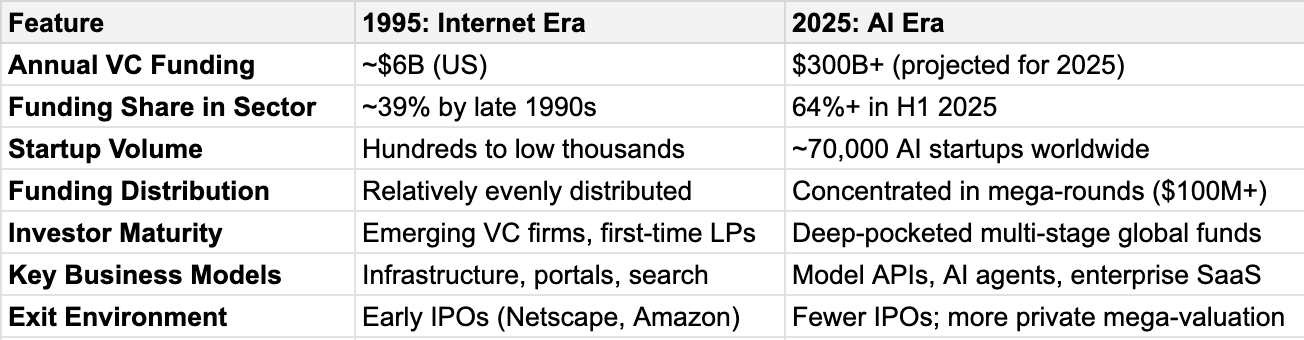
From dial-up to deep learning: a comparative study of the 1995 internet boom vs the 2025 AI surge

Technological revolutions often arrive with similar rhythms—early excitement, massive investment, and transformative outcomes. But no two waves are truly alike. This essay examines two pivotal innovation booms: the rise of internet companies in 1995 and the explosive growth of AI startups in 2025. By comparing key indicators—startup formation, venture funding, investor behavior, and macro trends—we can better understand how the AI surge mirrors, diverges from, and ultimately dwarfs the internet wave in both scale and complexity.

I. 1995: The Dawn of the Commercial Internet

In 1995, the internet was still a novel frontier. Browsers like Netscape Navigator had just emerged, and most households still accessed the web via dial-up. But beneath the surface, a venture capital engine was quietly igniting a revolution.

Key Stats from 1995:

  • Total VC Investment (US): ~$5.9 billion
  • Internet-Focused Startups: Hundreds globally; early giants like Yahoo!, eBay, and Amazon emerged
  • Number of VC Firms: ~400 by late 1990s, many just starting
  • Notable Rounds: Yahoo! raised $1M at a $4M valuation; Netscape IPO’d at $28 per share, surging to $75 on day one
  • Market Belief: Uncertain but optimistic; investors knew change was coming but didn’t know how

Key Characteristics:

  • Infrastructure-focused: Startups built the early tools—browsers, portals, search engines
  • Broad experimentation: No dominant playbook existed; categories were still forming
  • VC expansion: The number of firms and funds grew rapidly in response to demand

II. 2025: The Age of Applied Intelligence

Fast forward to 2025: AI is no longer theoretical. From foundational models and agents to vertical SaaS and AI-native tools, the industry is exploding in both capability and capital.

Key Stats from 2025 (H1):

  • Total US Startup Funding: $162.8 billion
  • AI’s Share of VC Deal Value: 64.1%
  • Estimated Number of AI Companies: ~70,000 globally (~17,500 in the US)
  • Mega-Rounds: 69% of AI capital went to rounds of $100M+
  • Standout Deals: OpenAI raised $40B at a $300B valuation; Anthropic, xAI, Mistral, and others raised billions each

Key Characteristics:

  • Massive scale: AI isn’t just one sector—it spans infrastructure, consumer, enterprise, and government applications
  • Concentration of capital: Unlike 1995, funding is heavily skewed toward a few elite players
  • Vertical integration: Foundational model companies, hardware partners, and distribution ecosystems are tightly linked
  • Enterprise focus: While consumer AI exists, enterprise use cases dominate monetization

III. Comparing the Two Booms


IV. Patterns and Contrasts

1. Scale and Speed

The internet boom took years to mature. In contrast, AI’s trajectory has compressed into months. What took 5–7 years during the 90s now happens in 12–24 months. This is driven by existing infrastructure, global capital, and the internet itself enabling faster diffusion.

2. Market Knowledge

In 1995, nobody knew what would “win.” Today’s investors have decades of pattern recognition. AI founders pitch within a mature framework of traction metrics, TAM estimates, and scalability models. This compresses funding timelines and increases investment stakes.

3. Capital Concentration

Internet investing in the 90s was spread across early-stage bets. In 2025, AI funding is barbelled: massive checks go to a few model-layer giants, while long-tail builders compete for scraps. This creates a winner-takes-most landscape with fewer middle-tier outcomes.

4. Regulatory Uncertainty

Both booms faced unknowns—privacy, legality, standards. But AI enters a much more regulated, politically sensitive global environment. The speed of regulation may impact its long-term shape more heavily than the internet faced.

V. Strategic Implications for Founders and Investors

  • For Founders: AI is not just a tech shift—it’s a distribution and decision-making shift. The path to value creation increasingly depends on moats around data, model fine-tuning, UX, and go-to-market execution, not just raw innovation.
  • For Investors: Spray-and-pray is no longer viable. The cost of participation has skyrocketed, and follow-on rounds require deep conviction and war chests. The alpha lies in signal detection—knowing which companies are building defensible systems, not demos.

The internet boom of 1995 laid the digital foundation of modern life. The AI boom of 2025 may reshape how that life is interpreted, augmented, and optimized. While the two share some DNA—early hype, rapid capital influx, foundational uncertainty—they differ in their maturity, speed, and strategic complexity.

In 1995, we connected computers. In 2025, we’re training them to think. And the real race is just beginning.

Author adminPosted on July 21, 2025December 26, 2025Tags decisions, judgment, organizations, risk, uncertainty

Posts pagination

Page 1 Page 2 … Page 5 Next page

Recent Posts

  • How to Detect Logic Leaks in Your Board Decks: The Signal Audit Approach
  • The real risk is rarely the decision you’re arguing about
  • When progress becomes the most dangerous illusion
  • Most irreversible decisions don’t look risky when they’re made
  • When reasonable decisions quietly turn expensive

Recent Comments

No comments to show.
  • Work
  • Forensic Review
  • Insights
  • About
  • Request Review
Vitaly Solten Proudly powered by WordPress