How to prepare for a VC meeting

The Signal-Aligned Edition

You’ve landed the meeting.
The VC is on the calendar.
Now what?

Most founders rush to polish their deck and rehearse their pitch.
But the real edge doesn’t come from what you say—
It comes from how clearly your signals align.

In this edition, I’ll walk you through how to prepare for a VC meeting using the Signal OS™ lens—so your story, strategy, and signals all point in the same direction.

Why Most Pitches Fall Flat

It’s not because of bad products.
Or weak metrics.

It’s because investors hear the words—
but don’t see the alignment behind them.

Your pitch needs to answer an unspoken question:
“Is this startup running on signal—or noise?”

Let’s make sure yours does.

The Signal-Aligned VC Prep Checklist

Each of the 5 Signals represents a layer of clarity VCs are scanning for—whether they say it or not.

1. Vision:

  • Is your core belief clear and compelling?
  • What shift in the world are you betting on?
  • Can you explain your startup without jargon—in one sharp sentence?

Prompt: “If an investor asked, ‘What are you really betting on?’—what would you say?”

2. Value:

  • What painful, undeniable problem are you solving?
  • Why now? Why this? Why you?
  • Are users desperate to use it—or just interested?

Prompt: “What happens if this startup doesn’t exist in 5 years? Who suffers?”

3. System:

  • How do your decisions align with your thesis?
  • What does your roadmap look like—beyond features and fire drills?
  • Are you scaling clarity—or chaos?

Prompt: “What’s your internal operating model—and how does it keep you aligned?”

4. Market:

  • Is the market real, accessible, and active?
  • Are you solving for a niche, or lost in a crowd?
  • Do you know how this market adopts and buys?

Prompt: “Who is already trying to solve this—and what are they missing?”

5. Momentum:

  • What traction proves the signals are working?
  • Are users returning, referring, or just testing?
  • Are you measuring the right indicators?

Prompt: “What have you learned from your current traction—and how has it shaped your plan?”

Pro Tips Before You Walk In

  • Don’t memorize—internalize. VCs will probe around the edges. Signal strength comes from conviction, not scripting.
  • Anticipate signal friction. Know where your weakest signal is—and be ready to talk about it with honesty and logic.
  • Make it conversational. Don’t just pitch. Invite discussion. Ask for feedback. You’re evaluating alignment, too.
  • Close with clarity. Make your final minute a sharp, belief-driven close: “Here’s what we believe, what we’ve proven, and why we’re the ones to build it.”

How to Break Into the Top 1% of Small Businesses Earning $40M+ Annually

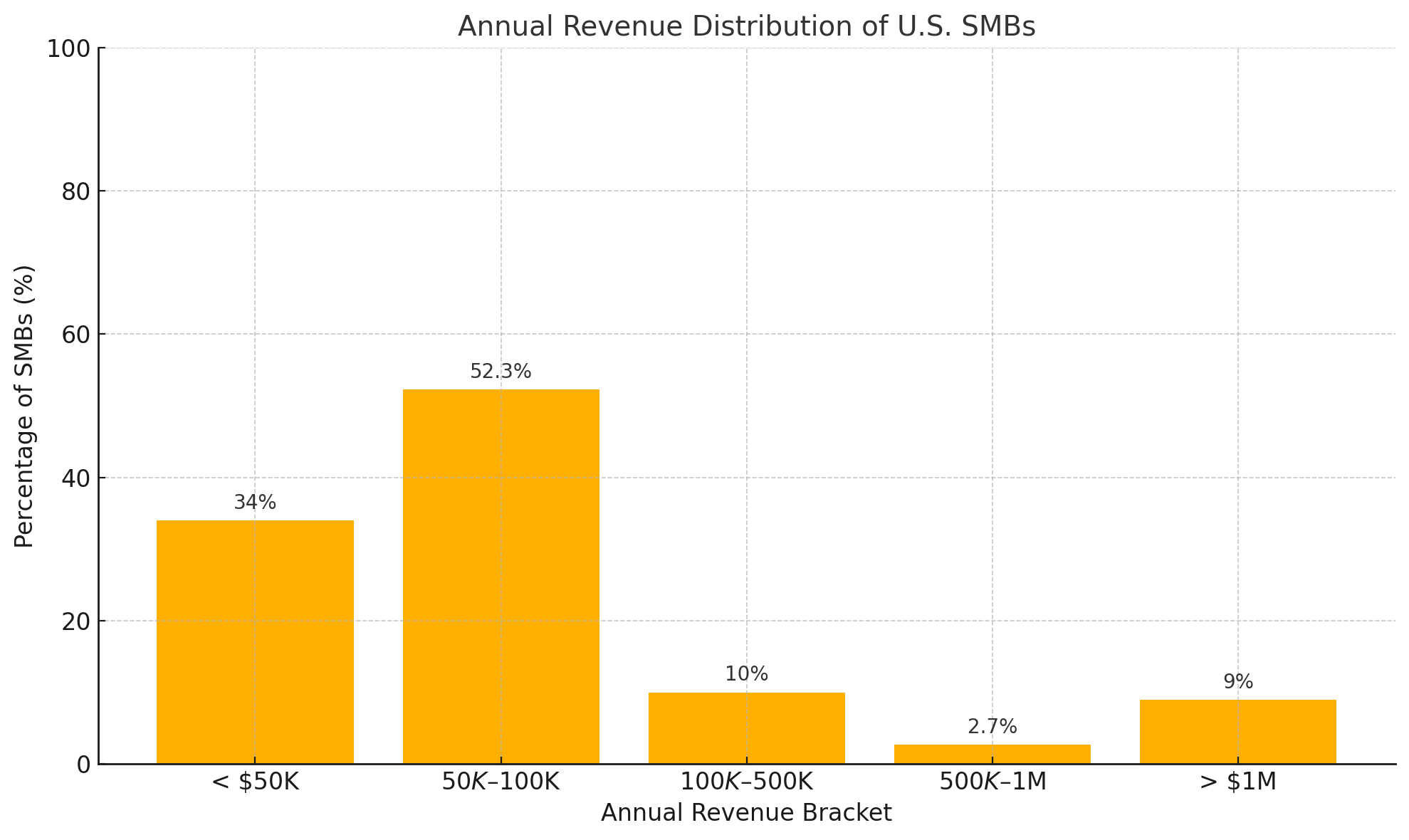
Out of nearly 35 million small businesses in the U.S., only a fraction ever break the $1 million revenue mark. Fewer still reach the top 1% that earn $40 million or more per year. What makes these outliers different? Why do some businesses scale while others plateau?

The Landscape of U.S. Small Business Revenue

Most small businesses are just that: small.

  • ~82% are non-employer firms (solo operators)
  • ~86% of SMBs make under $100,000 annually
  • Fewer than 9% earn more than $1 million
  • Only 1% ever approach $40 million and beyond

This isn’t just a numbers game. It’s a structural pattern. Most businesses are built for survival, not for scale.

Why Most Businesses Stay Small

  1. Lack of Leverage
    • Many founders sell time, not outcomes. This caps growth.
    • Without systems, people, or tech to scale, growth becomes linear.
  2. Comfort in Control
    • Founders stay inside the business instead of building the business.
    • Delegation is feared. Systems are avoided. Scaling is delayed.
  3. Misaligned Models
    • Business models aren’t designed for exponential growth.
    • High overhead and low margins create a ceiling.
  4. No Strategic Operating System
    • Decision-making is reactive, not strategic.
    • There’s no framework to align vision, value, market, and momentum.

What the Top 1% Do Differently

  1. They Think Bigger From Day One
    • They don’t just ask: “How do I make money?”
    • They ask: “How do I build an engine that prints money without me?”
  2. They Build Systems, Not Just Products
    • Sales engines, hiring machines, delivery pipelines—they productize the business itself.
  3. They Align Everything
    • Market demand, business model, team incentives, and customer value all work together.
  4. They Outgrow Their Identity
    • They become CEOs, not service providers.
    • They replace hustle with structure, and intuition with signal.

How to Begin the Climb

If you want to break into the top 1%, you don’t start with hustle—you start with alignment.

  • Align your vision with a scalable market.
  • Build systems that scale your delivery, sales, and strategy.
  • Move from reaction to strategy using an operating system.

This Is Why We Built Signal OS

At Signal OS, we help founders break past invisible ceilings. We align the five core signals of scalable success: Vision, Value, System, Market, and Momentum.

Because most businesses fail not from lack of effort—but from lack of alignment.

If you’re ready to scale, don’t just work harder. Work aligned.

Learn more: https://vitalysolten.com/signal-os/

What Is Strategic Advisory? And Why Founders Need It Earlier Than They Think.

Most founders wait too long to ask for help.
Not because they lack ambition—
but because they don’t know what kind of help they actually need.

They think they need a coach.
Or a consultant.
Or another framework.

But what they really need—especially in the early stages—is clarity.
And that’s where Strategic Advisory comes in.

What is Strategic Advisory?

Strategic Advisory isn’t about giving you tasks. It’s not a set of templates or a one-size-fits-all playbook.

It’s a structured partnership focused on one goal:
Helping you make better, clearer decisions—before you scale.

This means:

  • Uncovering misalignments across vision, product, team, and market
  • Pressure-testing your assumptions early
  • Designing a strategy that supports real traction, not just motion
  • Acting as a true thought partner—not an operator or cheerleader

You bring the ambition.
A Strategic Advisor brings clarity, pattern recognition, and aligned direction.

How It’s Different from Coaching or Mentoring

A coach focuses on behavior.
A mentor shares stories from their past.
A consultant gives you a report.

But a Strategic Advisor thinks alongside you.

Not just about what you do, but what you believe—and how that belief shows up in your decisions, roadmap, and positioning.

Strategic Advisory isn’t motivational. It’s directional.

Why You Need It Earlier Than You Think

Most founders only seek advisory help when they hit a wall—
when metrics stall, when investors start pressing harder, or when clarity is lost.

But misalignment doesn’t start loud.
It compounds quietly.

The best time to bring in a Strategic Advisor isn’t when the fire starts.
It’s before you pour fuel on it.

The earlier you align, the more everything compounds in the right direction.

Signs You Might Need It Now

Ask yourself:

  • Are we building fast—but unsure if we’re building the right thing?
  • Is our traction scattered, not compounding?
  • Do we struggle to articulate what we really do and why it matters?
  • Are we chasing goals that feel disconnected from our actual direction?

If so, it’s not about hustle. It’s about alignment.

How I Help

As a Strategic Advisor, I help founders like you:

  • Align your company around a clear thesis using my 5 Signals™ Framework
  • Diagnose strategic drift before it scales
  • Build a focused operating system for decisions and growth
  • Save time, money, and sanity by aligning before scaling

It’s not slides or scripts. It’s sharp, honest signal thinking—customized to your company’s reality.

You Don’t Need More Speed. You Need a Better Map.

Why Strategic Advisory Isn’t About More Hustle — It’s About Smarter Navigation

Speed is intoxicating.

In the startup world, it’s practically religion:
“Move fast and break things.”
“If you’re not embarrassed by your first product…”
“Fail fast. Iterate faster.”

And sure, there’s value in velocity — when it’s aligned.
But over and over, I’ve seen something else play out:

Startups that move fast… in the wrong direction.

Speed Without Strategy Is Just Efficient Drift

It’s easy to confuse movement with momentum.
Easy to build, ship, hire, raise — all with incredible energy.
But what happens when none of it compounds?

I’ve worked with founders who burned through funding, exhausted teams, and lost confidence — not because they were slow, but because they had no clear map.

They didn’t lack execution.
They lacked orientation.

What a “Map” Actually Means

In Strategic Advisory, we start with a few basic questions:

  • What’s your core belief about the business you’re building?
  • What conditions must be true for that belief to work?
  • Are your team, actions, and model aligned with that?
  • Are you scaling traction — or just activity?

This is what I call Signal Thinking — a way of aligning what you believe, build, and track. It’s how speed becomes strategic instead of chaotic.

Fast Without Friction ≠ Sustainable

If your internal clarity is missing, no amount of growth will fix it.
In fact, it will probably break you faster.

That’s the paradox:
The faster you move, the more expensive misalignment becomes.

What Strategic Advisory Actually Does

Here’s how I work with founders and early-stage teams:

  • We align your map — so your vision, model, market, and momentum are in sync.
  • We identify drift — where speed is hiding misalignment.
  • We make decisions visible — so you stop reacting and start compounding.

It’s not mentorship.
It’s not coaching.
It’s structured thinking to protect your edge.

Want a better map?

If you’re scaling but feel off-track…
If you’re growing, but it’s not compounding…
Or if you want to build your business on something solid —

Let’s talk.

Signal OS™: The Founder Edition, Second Edition — Now Available

After working with founders, advisors, and startup mentors around the world, I’m excited to announce the Second Edition of Signal OS™: The Founder Edition — a self-guided strategic system designed to help you build an aligned, fundable, and scalable startup.

🚀 What’s New in This Edition?

  • Fully refined structure with expanded tools and clarity models
  • Updated Signal Audit with a visual scoring system
  • More misalignment patterns and case vignettes
  • Enhanced founder–investor alignment section
  • Streamlined tools for pre-raise readiness and clarity rituals

🧠 Why Signal OS Still Matters

Most founders don’t fail from lack of effort — they fail from misalignment.
Signal OS™ is built to help you detect blind spots before they cost you.

Whether you’re pre-seed or post-product, this system gives you a structured lens to:

  • Align with your co-founders
  • Understand what your traction actually signals
  • Communicate with investors more clearly
  • Build without confusion

📦 What You’ll Get

68+ pages of founder-first strategy
The full 5 Signals™ framework
Strategic Audit + Scorecard
Investor conversation prep sheet
Alignment tools + rituals
Signal Memo Template + 1-page canvas
And more

💬 What Founders Are Saying

“This made me step back and look at our startup with sharper eyes.”
“Helped us get aligned before fundraising — saved us months.”
“I wish I had this during our last pivot.”

🎯 Get the OS Now

The Second Edition is now available at https://vitalysolten.com/signal-os/

Whether you’re building your first startup or refining your next raise, Signal OS™ will help you build with clarity — not chaos.

Strategic Signal Thinking: The founder’s edge in a noisy world

In today’s startup world, clarity is rare — and that makes it powerful.

Founders are flooded with data, pressure, and advice.

Everyone wants to scale.

Everyone wants growth.

But few pause to ask:

Are we building in the right direction?

Welcome to Strategic Signal Thinking™ — a new mental model designed to help founders navigate complexity with clarity.

The Problem: Noise ≠ Progress

Startups often confuse activity for alignment.

They’re shipping fast. Raising funds. Hiring teams. Hustling hard.

But underneath all that motion, many teams are quietly misaligned — and don’t know it until it’s too late.

  • The vision gets fuzzy
  • The value becomes unclear
  • The strategy shifts without notice
  • The market isn’t actually responding
  • Momentum is chaotic, not coherent

That’s not a traction problem.

It’s a signal problem.

What Is Strategic Signal Thinking?

It’s the shift from chasing performance to recognizing strategic signals.

While metrics tell you what already happened, signals help you see what’s really happening — and what comes next.

Signal Thinking is the ability to detect, align, and act on what matters most — before it becomes visible in the numbers.

The 5 Signals™ Framework

At the heart of Signal Thinking is a simple yet powerful diagnostic model — the 5 Signals™. Together, they form the operating system behind every resilient, scalable company.

1. Vision

→ Is the founding vision still clear, compelling, and aligned across the team?

2. Value

→ Are we creating a real, differentiated, and needed solution?

3. Strategy

→ Do we have a clear path — and are we making decisions aligned with that path?

4. Market

→ Are we engaging the right audience, and are they responding?

5. Momentum

→ Are we actually moving forward — or just busy?

When these five signals align, founders build with focus, resilience, and investor-ready clarity.

When do they drift?

Misalignment compounds — quietly, then suddenly.

Why This Matters Now

In a high-noise, high-pressure environment, strategic clarity is your edge.

Founders who adopt signal thinking:

  • Spot issues before they become problems
  • Build teams that align instead of just execute
  • Communicate conviction to investors and customers
  • Grow with confidence — not chaos

Startups don’t fail from lack of effort.

They fail from scaling misalignment.

Ready to See Your Signals?

Take 5 minutes to complete the free Signal Audit Lite™ — a diagnostic tool to help you evaluate your startup’s current signal strength.

✅ Get your personalized Signal Score™

✅ Spot areas of risk and clarity

✅ Walk away with a framework to align your next move

Start here: https://vitalysolten.com/interactive-signal-self-test/

Every founder is betting on something.

Signal Thinking helps you see what you’re betting on — and whether it’s still true.

Because in a noisy world, the real advantage isn’t speed.

It’s alignment.

If they ask why it’s so expensive, they don’t understand what they’re paying for

There’s a moment in almost every client conversation that triggers a little alarm in my head.

It’s when someone says:

“That seems expensive.”

Now, they don’t say it with aggression. Often, it’s a genuine question—maybe even curiosity. But here’s the thing:

When a client asks why something costs what it does, it doesn’t necessarily mean your price is high.

It means they don’t fully understand what they’re paying for.

And more importantly, it means you haven’t helped them see it yet.

The value gap

Over the years, I’ve noticed something else—something even more common, especially among early-stage founders and entrepreneurs:

They often don’t know how much their own product or service should cost.

They’re unsure whether they’re charging too much or too little.

They haven’t tested real price elasticity.

They haven’t spoken to enough people who’ve paid—actually paid—for what they’re offering.

Most importantly, they underestimate what they’re creating.

They focus on features, deliverables, timelines. But buyers? Buyers don’t care about inputs. They care about outcomes.

Here’s a story

A few years ago, I was advising a founder who built a brilliant compliance tool for regulated startups. When I asked how much he was charging, he said:

“$49 a month.”

This was a product that could save companies tens of thousands in fines and audits.

It reduced legal risks.

It automated documentation.

It literally kept people out of trouble.

And yet—he priced it like a nice lunch.

Why?

Because he calculated effort, not impact.

Because no one had ever asked him, “What’s the cost of not using your product?”

He didn’t see the value. So, of course, his customers didn’t either.

Clarity ≠ confidence

Startups love to talk about clarity—clarity of messaging, positioning, product-market fit.

But price clarity is a different beast.

It requires you to believe in what you’re building.

It forces you to put a number next to your value—and live with that number.

That’s hard. But it’s necessary.

Because if you don’t know the value of what you’re offering,

your customer certainly won’t either.

So what do you do?

  1. Test value, not comfort.

    Price discomfort is good. It’s a sign you’re pushing into real conversations about value.

  2. Anchor to outcomes.

    Don’t ask, “Is this worth $X?”

    Ask, “What would it cost the client not to solve this problem?”

  3. Listen for hesitations.

    When someone questions your pricing, don’t get defensive. Ask what they expected. Their answer will tell you where the gap is—in your framing, in their understanding, or both.

  4. Stop discounting your genius.

    If your work changes outcomes, reduces risk, accelerates growth—price like it does. You’re not selling hours. You’re selling progress.

So…

When someone says “That’s expensive,”
they’re not always pushing back on your price.
Sometimes, they’re just waiting for you to help them see what it’s really worth.

Don’t lower the number.
Raise the clarity.

Solten Consulting launches new pre-investment due diligence offering featuring the Solten Score™ for startup financing readiness

In response to the growing demand for specialized investment readiness support, Solten Consulting has unveiled an enhanced service offering focused exclusively on pre-investment audits and startup financing preparation. At the center of this offering is the newly introduced Solten Score™, a proprietary metric designed to quantify a startup’s readiness for investment.

This evolution marks a key milestone in Solten Consulting’s mission to help founders navigate the high-stakes journey toward funding with greater clarity, structure, and confidence—while continuing to offer strategic consulting for companies across all growth stages.

Why this shift?

Over time, Solten Consulting identified a common challenge among early-stage startups: the gap between strategic intent and investor expectations. Startups weren’t just looking for advice—they needed investor-facing, data-informed support that could transform potential into actual capital readiness.

“We’ve always included investment readiness in our work with startups,” said Vitaly Solten, Founder and CSO of Solten Consulting. “But as we saw patterns emerge, it became clear that what founders truly needed was a measurable, structured approach to prepare for due diligence and investor conversations. That’s why we created the Solten Score™.”

What the solten score™ measures

The Solten Score™ is a proprietary evaluation framework used within Solten Consulting’s pre-investment audit process. It provides a clear, objective view of a startup’s investment readiness across key dimensions, including:

  • Financial clarity

  • Operational scalability

  • Market validation

  • Founding team strength

  • Investor alignment

This scoring system helps both founders and investors identify strengths, address gaps, and accelerate the path to funding—with full transparency and actionable guidance.

A structured offering for investor readiness

Solten Consulting’s pre-investment readiness offering now includes:

  • Pre-investment audit – A detailed review of financials, operations, product-market fit, compliance, and founder-market alignment.

  • Business optimization for investment – Tailored guidance to refine business models, go-to-market strategy, and investor positioning.

  • Investor-ready strategy – Strategic support for pitch refinement, data room creation, and investor engagement.

All of these services integrate the Solten Score™ to provide a benchmarked, investor-grade assessment of where the startup stands—and what’s needed to move forward.

Why it matters

In today’s capital landscape, especially in verticals like AI, climate tech, and B2B SaaS, investors are more selective and data-driven than ever. Founders need more than storytelling—they need evidence of execution and signals of scalability.

“The Solten Score™ helps founders speak the investor’s language,” said Solten. “It brings objectivity to the process, creates alignment, and builds confidence on both sides of the table.”

Solten Consulting’s broader mission

While this investment readiness program takes a front seat, Solten Consulting continues to serve founders and executive teams with broader strategy, market entry, product positioning, and growth consulting.

By integrating the Solten Score™ into its services, the firm is deepening its commitment to founder success—whether the next step is seed funding, Series A, or scaling toward profitability.

Ready to raise?

Startups preparing for funding rounds can now access Solten Consulting’s pre-investment readiness services powered by the Solten Score™.

Visit vitalysolten.com or reach out to hello@vitalysolten.com to schedule your assessment.

Marketing in the shadows: How to promote a business in a confidential market like TSCM

In many industries, marketing relies heavily on testimonials, case studies, and public success stories. But what happens when you’re in a field where confidentiality is paramount? The Technical Surveillance Countermeasures (TSCM) market is one such domain. Clients demand absolute discretion, businesses cannot disclose past projects, and there’s little publicly available data on industry trends.

So, how do you attract clients when you can’t talk about your work? Let’s explore strategic approaches to building credibility, visibility, and trust in a market that thrives on secrecy.

1. Focus on thought leadership, not сlient names

Since public case studies are not an option, an alternative is to establish credibility through thought leadership. Instead of showcasing specific projects, companies can share insights on trends in eavesdropping threats, risk mitigation strategies, and the evolution of surveillance technology.

Actionable Steps:

• Publish industry reports on emerging security threats without revealing client specifics.

• Write educational articles on how businesses can protect their sensitive communications.

• Host webinars or private briefings for potential clients to discuss evolving risks and countermeasures.

By positioning your company as an authority in the field, you gain trust even without disclosing your work.

2. Leverage hypothetical and aggregated data

While you can’t discuss real cases, you can build trust using hypothetical scenarios or aggregated insights from past work. Instead of saying, “We helped Company X prevent a data breach,” you can present generalized statistics such as:

“In the past year, 60% of corporate espionage attempts we detected involved unauthorized wireless devices.”

Actionable Steps:

• Use industry-wide trends to highlight common vulnerabilities.

• Craft plausible yet fictionalized scenarios demonstrating the risks businesses face.

• Share anonymous success metrics, like the percentage of threats mitigated.

By shaping a data-driven narrative, clients see the value of your services without compromising confidentiality.

3. Build a strong referral and partnership network

Word-of-mouth marketing is incredibly powerful in industries where trust is essential. In the TSCM market, decision-makers often rely on recommendations from peers rather than online searches. A strong referral and partnership system can be more effective than traditional advertising.

Actionable Steps:

• Encourage existing clients to refer your services discreetly.

• Partner with law firms, cybersecurity firms, and corporate security divisions who may refer clients in need of TSCM.

• Engage with industry associations and closed forums where security professionals discuss solutions.

A referral-first approach aligns with the private nature of the business while driving high-value leads.

4. Invest in private networking and invite-only events

In industries where trust is critical, business development happens in closed circles. Traditional advertising won’t work, but private networking will.

Actionable Steps:

• Organize exclusive, invite-only security briefings for executives concerned about surveillance threats.

• Attend closed-door industry events where potential clients gather.

• Develop a high-trust community, such as a private club for corporate security leaders to discuss counter-surveillance strategies.

Instead of broadcasting services, create opportunities for direct engagement with decision-makers.

5. Strengthen brand reputation through certifications and accreditations

Since direct marketing is challenging, companies must establish credibility through third-party validation. Certifications, compliance standards, and memberships in elite security organizations reinforce your expertise.

Actionable Steps:

• Obtain recognized TSCM and cybersecurity certifications (e.g., ITAR compliance, ISO 27001).

• Join respected security associations (e.g., Espionage Research Institutes, Government Security Councils).

• Ensure strong media mentions in reputable security and business publications.

When potential clients research your firm, they should find a track record of excellence and credibility—even if they don’t see specific client testimonials.

6. Use high-level branding and subtle messaging

For companies in the TSCM space, branding should evoke trust, discretion, and authority without revealing specifics. The message should focus on capabilities rather than projects.

Actionable Steps:

• Craft a website and marketing materials that emphasize discretion, expertise, and risk mitigation.

• Avoid overly technical language—focus on the business impact (e.g., “Protecting Your Most Sensitive Conversations”).

• Use visual storytelling, such as symbolic imagery (e.g., shields, encrypted signals, or abstract security metaphors) rather than direct product images.

The key is to attract the right audience without exposing too much about how you operate.

The art of silent marketing

Promoting services in a confidential industry like TSCM requires a strategic, trust-driven approach. Rather than relying on conventional marketing tactics, companies must position themselves as authorities, leverage private networks, and build trust through discretion.

While you can’t showcase your clients, you can showcase your expertise, credibility, and commitment to security. In an industry where silence is golden, the right approach isn’t about shouting your achievements—it’s about ensuring the right people hear your message in the right way.
Cracking the code: A new business strategy for Merit Security

A few weeks ago, I took on a new challenge—developing a business strategy for Merit Security, a company that specializes in Technical Surveillance Counter Measures (TSCM). It’s an industry that operates in the shadows, protecting businesses and individuals from espionage, eavesdropping, and security threats most people don’t even realize exist.

And here’s the catch: This market is one of the toughest to modernize

The challenge: An old-school industry with no playbook

The TSCM industry is highly conservative, discreet, and deeply rooted in traditional practices. Unlike tech startups, SaaS companies, or even cybersecurity firms, there’s no abundance of market data, no playbook for scaling, and no clear path to business transformation.

Most companies in this space operate with word-of-mouth referrals, government contracts, and private networks. They don’t advertise aggressively, and they rarely innovate in business strategy. It’s a tight-knit, old-world industry, and that’s precisely what makes this project so interesting.

Breaking new ground

So how do you build a scalable and sustainable business strategy in a market that resists change? That’s the puzzle I’m solving right now.
• How do we position a TSCM company for long-term growth in a world where traditional sales and marketing strategies don’t work?
• What role does technology play in modernizing service offerings?
• How do we educate potential clients who don’t even know they need TSCM services?

These are just some of the questions I’m tackling as I dig into the market, analyze the competitive landscape, and look for new ways to drive revenue and expand business operations.

Why this project excites me

I thrive on solving complex business problems, and Merit Security’s challenge is exactly the kind of project I love—a real opportunity to rethink an industry that’s been operating the same way for decades.

There’s no easy path, no case studies to follow, no guaranteed formula for success. But that’s what makes it worth doing.

Over the next few months, I’ll be working through this challenge—experimenting, strategizing, and designing a business model that works without compromising the discretion and integrity that define the TSCM industry.

If you’re interested in following this journey, stay tuned. I’ll be sharing insights along the way.

And if you have thoughts, questions, or ideas about strategy in hard-to-scale industries, let’s talk.