Due Diligence from the Other Side: A Founder’s Guide to Self-Auditing

“Due diligence isn’t just something that happens to you. It’s a mirror — if you’re willing to look.”

Most founders fear due diligence.

Not because they’re hiding anything — but because they don’t know what’s coming. The process feels opaque, unpredictable, and often adversarial.

But it doesn’t have to be.

When done right, due diligence isn’t a trap. It’s a flashlight. And the smartest founders don’t wait for it — they run their own internal audit before investors ever touch their data room.

Why Reverse Diligence Matters

Investors aren’t just checking boxes. They’re pattern-matching. They’re looking for inconsistencies, gaps in logic, or signs of chaos under the hood. Most red flags don’t come from bad intentions — they come from unexamined assumptions.

By preemptively auditing your own business like an investor would, you gain three unfair advantages:

  1. You fix risks before they surface.

  2. You tell a more confident, signal-aligned story.

  3. You save everyone time — including yourself.

The result? More yeses. Faster closes. And far less post-term sheet regret.

🔍 How to Run a Founder-Driven Self-Audit

This isn’t just about paperwork. It’s about strategic coherence. Let’s walk through the key layers investors look at — and how to self-check them.

1.

Vision & Founder Narrative

What investors look for:

A compelling “why now,” clear founder-market fit, and narrative coherence between origin and current trajectory.

Self-check:

  • Does your vision evolve with traction, or is it stuck in the past?

  • Can you clearly explain why you are uniquely positioned to build this?

  • Is your narrative consistent across deck, site, and conversations?

Red Flag to Fix:

A dated origin story that doesn’t match today’s product or market.

2.

Market Realism

What investors look for:

A growing market with urgent pain, clear segmentation, and data-backed TAM/SAM/SOM logic.

Self-check:

  • Is your market a category — or a vague audience?

  • Can you defend your assumptions with evidence?

  • Are you riding a wave, or trying to create one from scratch?

Red Flag to Fix:

Top-down TAM slides with no supporting bottoms-up logic.

3.

Customer Insight & Traction Quality

What investors look for:

Proof of real user demand — not just vanity metrics.

Self-check:

  • Do your traction numbers show pull or just push?

  • Can you map user feedback to product decisions?

  • Is retention happening — or just acquisition?

Red Flag to Fix:

Churn masked by aggressive paid growth.

4.

Business Model & Financial Hygiene

What investors look for:

Unit economics that make sense, responsible burn, and realistic projections.

Self-check:

  • Are your CAC and LTV estimates grounded or aspirational?

  • Do your forecasts reflect reality or wishful growth curves?

  • Are there messy financial structures or early-stage accounting gaps?

Red Flag to Fix:

Overly optimistic revenue projections with no clear growth engine.

5.

Team & Execution Capacity

What investors look for:

A team that can scale, with clear ownership and minimal dependence on the founder.

Self-check:

  • Who owns what — really?

  • Are there gaps in key roles or over-dependence on one person?

  • Can this team survive a pivot or major shift?

Red Flag to Fix:

No clear succession or operational redundancy plan.

6.

Cap Table & Deal History

What investors look for:

A clean, understandable cap table and reasonable existing terms.

Self-check:

  • Is your cap table founder-friendly and transparent?

  • Are there legacy investors or advisors with unfavorable terms?

  • Have you diluted more than necessary?

Red Flag to Fix:

Complex SAFE stack with unclear conversion triggers.

🧭 Final Takeaway

Due diligence doesn’t start after the pitch — it starts when you build your company. Every decision leaves a trail. Every inconsistency becomes a clue. Every misalignment adds friction.

But the truth is: you know more than anyone where the weak spots are.

What makes a founder world-class isn’t perfection. It’s awareness and preemption. The ability to spot misalignment and resolve it before it becomes a liability.

So don’t fear due diligence.

Own it.

Run your own audit. Get outside perspective. Fix the signals before investors ever ask the question.

Because when you already know the answer, fundraising feels less like a minefield — and more like a reveal.

🔗 Want to run your own strategic audit?

Get the free founder self-check guide here → https://vitalysolten.com/signal-os

Why Most Pitch Decks Fail: It’s Not the Slides, It’s the Signals

The real reason investors pass—and how founders can fix the signal gaps killing their momentum

“Investors don’t fund decks. They fund signals.”

Let’s get one thing clear: Most investors don’t need 15 minutes to say no.

They only need one thing to be missing.

That one thing?

A signal that convinces them you’re on track to become investable, scalable, and inevitable.

And the truth is, most decks aren’t missing design polish.

They’re missing strategic coherence — the invisible throughline that tells the investor:

“This team knows where they’re going, why it matters, and what’s working.”

The Real Reasons Decks Fail

Every investor has their version of “the checklist”:

• Market size

• Traction

• Team

• Revenue

• Moat

• Product

But that’s not what kills most decks.

What kills a deck is what’s not said—or what’s said without strategic clarity.

In my audits, I’ve reviewed 100+ decks that looked great on the surface. But investors still passed. Why?

Because one or more critical signals were weak, noisy, or missing entirely.

Let’s break it down.

Signal Gap 1:

No Clear “Why Now”

You have a clever idea.

You built something solid.

But the investor still doesn’t feel urgency.

❌ What’s missing? The timing signal.

Why is this the right moment?

What shift, trend, or unmet demand makes this solution urgent?

Without this, you’re not pitching opportunity—you’re pitching curiosity. And curiosity doesn’t close rounds.

Signal Gap 2:

Confused Vision

Most decks explain what they’re building.

Few clearly communicate why it matters—and how it fits into a larger narrative.

❌ What’s missing? The vision signal.

What future are you building toward?

What’s the story behind the company—and is it coherent?

If investors can’t repeat your story after one read-through, your vision isn’t clear enough.

Signal Gap 3:

Shallow Strategy

You show some traction. A few wins.

But when the investor asks, “So what’s next?”—you fumble.

❌ What’s missing? The system signal.

Do your actions follow a plan—or just chase short-term movement?

Is your growth strategy designed or reactive?

Investors back systems, not stunts.

Signal Gap 4:

Misaligned Market

You claim a massive TAM.

But when investors dig in, the market story gets fuzzy.

❌ What’s missing? The market signal.

Have you found your real wedge in the market?

Do you know your ICP like a friend, not a persona?

When your market feels generic, investors assume your insights are too.

Signal Gap 5:

Stalled Momentum

You talk about growth.

But your charts show plateaus. Or worse: investor-dependent progress.

❌ What’s missing? The momentum signal.

Is your traction compounding—or manufactured?

Is something working without external intervention?

Investors want to pour gas on a fire—not light the first match.

What Investors Actually Want

Behind every pass is one of three thoughts:

  1. “This sounds interesting, but something doesn’t add up.”

  2. “They’re not ready yet. Too many unknowns.”

  3. “I’ve seen this before—and it didn’t work.”

Notice what’s missing from those rejections?

They’re not saying, “Your slides were ugly.”

They’re saying: “Your signals didn’t convince me.”

How to Fix It

Before you update your deck, ask these questions:

✅ Does our vision make sense to someone outside the company?

✅ Do we explain why now—not just why us?

✅ Are we showing proof of strategy, not just activity?

✅ Can we name and quantify our true market wedge?

✅ Is our momentum organic, or just noise?

If you’re not sure, it’s time for a signal audit.

Because design doesn’t win funding—clarity does.

Final Thought

If you want to raise serious capital, stop polishing your pitch deck in isolation.

Start strengthening your signals—and let your story speak for itself.

Need a second set of eyes before you pitch?

I offer Strategic Signal Reviews for serious founders preparing to raise.

Clarity before capital. Always.

🔗 Explore Strategic Advisory at VitalySolten.com

Clarity of Purpose: The First Law of Achievement

“Success begins with clear, written goals. Know exactly what you want and why.” — Brian Tracy, The Phoenix Seminar

In a world overflowing with distractions, the rarest commodity is clarity. And yet, clarity is the first—and perhaps most critical—step toward any meaningful achievement. Without it, we drift. With it, we accelerate.

Why Clarity Matters

Most people don’t fail because they lack talent or drive. They fail because they’re unclear. They don’t know what they truly want. They chase vague notions of “success” or “more,” but without a defined target, progress becomes guesswork.

Clarity of purpose transforms effort into results. It focuses attention, sharpens decision-making, and creates momentum. When you know exactly what you want and why, everything else becomes a tactic—not a question.

Written Goals as Anchors

Brian Tracy’s philosophy is simple but powerful: don’t just think your goals—write them down. Writing crystallizes thought. It forces you to move from abstraction to commitment. A written goal is no longer an idea; it’s a direction.

More importantly, it becomes a filter. Each decision, opportunity, or challenge can now be weighed against a single question: Does this get me closer to my goal?

The Power of “Why”

Purpose is the emotional fuel behind clarity. Knowing what you want is only half the equation. The why provides the drive. A goal without meaning is a task. A goal with meaning is a mission. When your goals are tied to purpose—something bigger than ego—they become resilient.

Clarity Is Not Static

Your goals evolve as you grow. What felt urgent last year may now feel irrelevant. That’s why clarity is a practice, not a one-time event. Revisit your goals. Rewrite them. Refine your purpose as your understanding deepens.

How to Get Clear (Today)

  • Ask yourself: What do I truly want—this year, this quarter, this week?

  • Write it down in one clear sentence.

  • Add your reason: Why does this matter to me?

  • Break it into one next action step.

  • Review and revise weekly.

Clarity doesn’t guarantee success, but confusion guarantees failure. The first signal of high achievement is knowing what you want and why—in writing, in detail, and with purpose.

The Unseen Gaps: Why Even Brilliant Strategies Can Fail (And How to Find Them)

As a founder or investor, you pour immense effort into crafting what you believe is a brilliant strategy. You’ve analyzed the market, built a strong team, and perhaps even secured funding. Yet, despite all the intelligence and hard work, many promising ventures stumble. Why? Often, it’s not due to a lack of effort or even a fundamentally bad idea, but rather the presence of unseen gaps and blind spots within the strategy itself.

These aren’t always glaring errors. They are subtle misalignments, unchecked assumptions, or overlooked market shifts that, left unaddressed, can quietly erode your foundation. Think of it like a perfectly designed bridge with a tiny, almost imperceptible crack in a crucial support beam. It might hold for a while, but under stress, that small flaw can lead to catastrophic failure.

Where Do These Gaps Come From?

Strategies develop these “cracks” for several common reasons:

  1. Founder Bias & Proximity: When you’re deeply embedded in your own vision, it’s incredibly hard to see its flaws. Your passion, while essential, can also create blind spots to potential weaknesses or alternative realities. You’re too close to the painting to see the smudges.
  2. Rapid Market Evolution: The startup world moves at lightning speed. A strategy perfectly suited for yesterday’s market might be subtly misaligned with today’s realities, and critically, tomorrow’s trends.
  3. Incomplete Information: No one has perfect information. Decisions are made based on available data, but what if critical pieces are missing or misinterpreted?
  4. Internal Silos: As teams grow, communication can break down. Different departments might be operating on slightly different strategic interpretations, leading to a fragmented execution.
  5. Focus on “What” Over “Why”: Many strategies detail what will be done, but not always the deeper why behind each decision, making it harder to adapt when the initial assumptions shift.

The Power of an Objective, Experienced Eye

This is where an objective, experienced perspective becomes invaluable. Someone who isn’t emotionally invested in the outcome, but who has spent decades navigating the complexities of startups and technology, can spot these unseen gaps. It’s about having someone who knows what questions to ask, where to dig, and what patterns to look for – patterns that often repeat across different industries and business models.

My 25+ years in the startup and technology space have been filled with building, growing, and yes, making many mistakes. This journey has taught me to identify the subtle cues that indicate a strategic problem before it escalates. It’s about bringing clarity and simplicity to complex situations, helping founders and investors build strong companies without wasting precious time and money.

Listening to the “Signals”

Over the years, I’ve developed frameworks, like Signal OS™, that help decode the true health of a strategy. It’s about recognizing that every business emits “signals” – some loud and clear, others faint and easily missed. Learning to interpret these signals allows you to proactively identify what’s missing in your plan and make timely adjustments. It’s less about reacting to crises and more about anticipating and preventing them.

Start Asking These Questions

To begin identifying potential issues in your own strategy or investment thesis, consider these foundational questions:

  1. “What core assumption, if proven wrong, would completely derail our entire strategy?” (And how are we actively testing or validating that assumption?)
  2. “Is our ideal customer profile (ICP) truly as narrow and specific as it needs to be, and are we reaching them efficiently?” (Often, strategies are too broad, leading to diluted efforts.)
  3. “If we stripped away all the bells and whistles, what is the single, undeniable value proposition we offer that no one else can replicate as effectively?” (And is our entire organization aligned on this core value?)

These questions are designed to cut through the noise and get to the heart of your strategic foundation.

Ready to Find Your Unseen Gaps?

Proactively identifying and addressing these gaps in your strategy or investment thesis is not just about avoiding failure; it’s about building a more resilient, focused, and ultimately successful venture.

If you’re ready to gain clarity and ensure your plans are as robust as they can be, visit vitalysolten.com to learn how I can help you find what’s missing and build stronger companies.

From SEO to GEO: The AI Shift That’s Rewriting the Rules of Search

Why Generative Engine Optimization (GEO) is the new frontier for visibility, credibility, and growth

Search isn’t what it used to be.

For the past two decades, SEO (Search Engine Optimization) has been the dominant playbook for visibility. You optimized for Google, built backlinks, chased keywords, and hoped to rank on page one. But today, something fundamental has changed:

Search is no longer just a list of links.

It’s an answer box powered by large language models (LLMs).

Ask ChatGPT, Perplexity, Claude, or Gemini a question, and they don’t return ten blue links. They return a synthesized, conversational answer. Which means…

The game has shifted from ranking pages to being cited by the model.

Welcome to GEO: Generative Engine Optimization.

From PageRank to PromptRank

Traditional SEO was built for indexing. GEO is built for inference.

Search engines parsed HTML, scanned for title tags and backlinks. But generative engines parse language, context, and clarity.

They favor:

  • Well-structured answers
  • Clear takeaways
  • Distilled insights
  • Factual summaries

And they don’t care how many backlinks you have — if your content doesn’t help the model answer a question, it won’t be referenced.

GEO is about being the source material behind the answer.

Citation is the New Click

In the SEO world, success was traffic. In the GEO world, success is citation.

That means:

  • Is your brand being mentioned by name in AI answers?
  • Are your frameworks, definitions, or insights being quoted?
  • Are you showing up when someone asks a smart question in your niche?

GEO is about authority without the click.

And in a world where AI answers dominate user attention, being part of that answer is the new growth channel.

Why This Matters Now

We’re still early.

AI-native search is accelerating, but the rules are still fluid. That means:

Now is the time to build generative visibility before everyone else catches on.

The brands that format their content clearly, test prompts, and show up in model outputs will have a durable advantage.

And unlike the SEO wars of the past, you don’t need to game algorithms. You need to publish useful thinking in a model-readable way.

Your Quick-Start GEO Checklist

1. Find Your Topics
What questions are people asking in your niche? Ask them in AI tools. Search yourself. Take note.

2. Structure for LLMs
Use clear headers, bullet points, and summaries. Make your ideas skimmable and citable.

3. Publish Citable Content
Rankings. Definitions. Frameworks. Insights. Use formats that models can extract and reuse.

4. Monitor AI Visibility
Use tools like Profound, BrandRadar, or Goodie to track citations across models.

5. Prompt-Test Your Work
Ask LLMs questions and see if they reference you. Refine until they do.

6. Refresh Old Posts
Reformat your best work into model-friendly formats. Repost it with a better structure.

7. Publish Often on Trusted Domains
LLMs still crawl open web content. Use Substack, Medium, Notion, or your own site with good metadata.

Final Thought

GEO isn’t a replacement for SEO. It’s the evolution of it.

In an AI-powered future, your visibility, trust, and growth will depend less on how many people click your link and more on how often the machine says your name.

Get cited. Get seen. Grow.

If you found this useful, follow along for more essays like this on the future of visibility, AI-native content, and how to win in the signal-based world.

How to prepare for a VC meeting

The Signal-Aligned Edition

You’ve landed the meeting.
The VC is on the calendar.
Now what?

Most founders rush to polish their deck and rehearse their pitch.
But the real edge doesn’t come from what you say—
It comes from how clearly your signals align.

In this edition, I’ll walk you through how to prepare for a VC meeting using the Signal OS™ lens—so your story, strategy, and signals all point in the same direction.

Why Most Pitches Fall Flat

It’s not because of bad products.
Or weak metrics.

It’s because investors hear the words—
but don’t see the alignment behind them.

Your pitch needs to answer an unspoken question:
“Is this startup running on signal—or noise?”

Let’s make sure yours does.

The Signal-Aligned VC Prep Checklist

Each of the 5 Signals represents a layer of clarity VCs are scanning for—whether they say it or not.

1. Vision:

  • Is your core belief clear and compelling?
  • What shift in the world are you betting on?
  • Can you explain your startup without jargon—in one sharp sentence?

Prompt: “If an investor asked, ‘What are you really betting on?’—what would you say?”

2. Value:

  • What painful, undeniable problem are you solving?
  • Why now? Why this? Why you?
  • Are users desperate to use it—or just interested?

Prompt: “What happens if this startup doesn’t exist in 5 years? Who suffers?”

3. System:

  • How do your decisions align with your thesis?
  • What does your roadmap look like—beyond features and fire drills?
  • Are you scaling clarity—or chaos?

Prompt: “What’s your internal operating model—and how does it keep you aligned?”

4. Market:

  • Is the market real, accessible, and active?
  • Are you solving for a niche, or lost in a crowd?
  • Do you know how this market adopts and buys?

Prompt: “Who is already trying to solve this—and what are they missing?”

5. Momentum:

  • What traction proves the signals are working?
  • Are users returning, referring, or just testing?
  • Are you measuring the right indicators?

Prompt: “What have you learned from your current traction—and how has it shaped your plan?”

Pro Tips Before You Walk In

  • Don’t memorize—internalize. VCs will probe around the edges. Signal strength comes from conviction, not scripting.
  • Anticipate signal friction. Know where your weakest signal is—and be ready to talk about it with honesty and logic.
  • Make it conversational. Don’t just pitch. Invite discussion. Ask for feedback. You’re evaluating alignment, too.
  • Close with clarity. Make your final minute a sharp, belief-driven close: “Here’s what we believe, what we’ve proven, and why we’re the ones to build it.”

How to Break Into the Top 1% of Small Businesses Earning $40M+ Annually

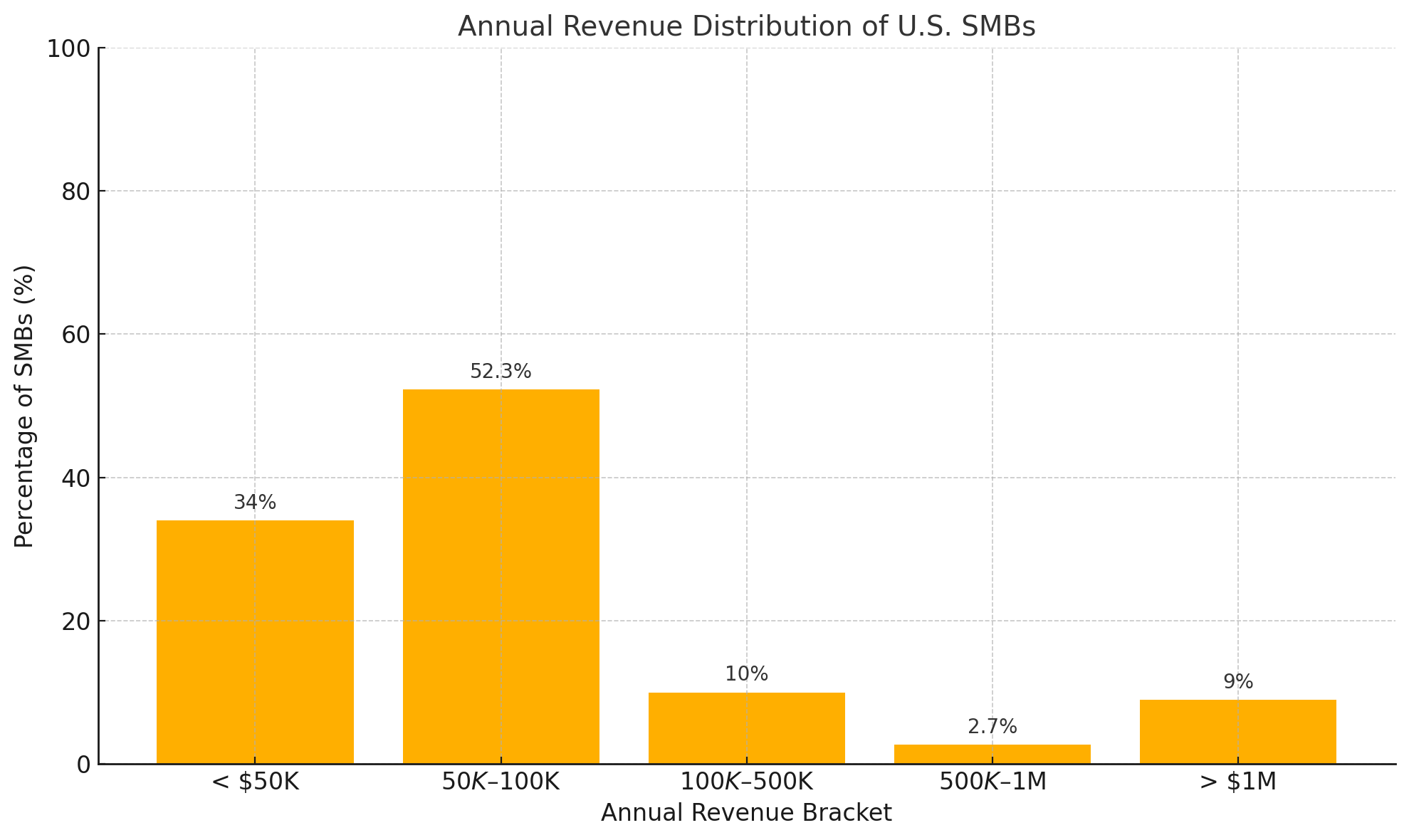
Out of nearly 35 million small businesses in the U.S., only a fraction ever break the $1 million revenue mark. Fewer still reach the top 1% that earn $40 million or more per year. What makes these outliers different? Why do some businesses scale while others plateau?

The Landscape of U.S. Small Business Revenue

Most small businesses are just that: small.

  • ~82% are non-employer firms (solo operators)
  • ~86% of SMBs make under $100,000 annually
  • Fewer than 9% earn more than $1 million
  • Only 1% ever approach $40 million and beyond

This isn’t just a numbers game. It’s a structural pattern. Most businesses are built for survival, not for scale.

Why Most Businesses Stay Small

  1. Lack of Leverage
    • Many founders sell time, not outcomes. This caps growth.
    • Without systems, people, or tech to scale, growth becomes linear.
  2. Comfort in Control
    • Founders stay inside the business instead of building the business.
    • Delegation is feared. Systems are avoided. Scaling is delayed.
  3. Misaligned Models
    • Business models aren’t designed for exponential growth.
    • High overhead and low margins create a ceiling.
  4. No Strategic Operating System
    • Decision-making is reactive, not strategic.
    • There’s no framework to align vision, value, market, and momentum.

What the Top 1% Do Differently

  1. They Think Bigger From Day One
    • They don’t just ask: “How do I make money?”
    • They ask: “How do I build an engine that prints money without me?”
  2. They Build Systems, Not Just Products
    • Sales engines, hiring machines, delivery pipelines—they productize the business itself.
  3. They Align Everything
    • Market demand, business model, team incentives, and customer value all work together.
  4. They Outgrow Their Identity
    • They become CEOs, not service providers.
    • They replace hustle with structure, and intuition with signal.

How to Begin the Climb

If you want to break into the top 1%, you don’t start with hustle—you start with alignment.

  • Align your vision with a scalable market.
  • Build systems that scale your delivery, sales, and strategy.
  • Move from reaction to strategy using an operating system.

This Is Why We Built Signal OS

At Signal OS, we help founders break past invisible ceilings. We align the five core signals of scalable success: Vision, Value, System, Market, and Momentum.

Because most businesses fail not from lack of effort—but from lack of alignment.

If you’re ready to scale, don’t just work harder. Work aligned.

Learn more: https://vitalysolten.com/signal-os/

What Is Strategic Advisory? And Why Founders Need It Earlier Than They Think.

Most founders wait too long to ask for help.
Not because they lack ambition—
but because they don’t know what kind of help they actually need.

They think they need a coach.
Or a consultant.
Or another framework.

But what they really need—especially in the early stages—is clarity.
And that’s where Strategic Advisory comes in.

What is Strategic Advisory?

Strategic Advisory isn’t about giving you tasks. It’s not a set of templates or a one-size-fits-all playbook.

It’s a structured partnership focused on one goal:
Helping you make better, clearer decisions—before you scale.

This means:

  • Uncovering misalignments across vision, product, team, and market
  • Pressure-testing your assumptions early
  • Designing a strategy that supports real traction, not just motion
  • Acting as a true thought partner—not an operator or cheerleader

You bring the ambition.
A Strategic Advisor brings clarity, pattern recognition, and aligned direction.

How It’s Different from Coaching or Mentoring

A coach focuses on behavior.
A mentor shares stories from their past.
A consultant gives you a report.

But a Strategic Advisor thinks alongside you.

Not just about what you do, but what you believe—and how that belief shows up in your decisions, roadmap, and positioning.

Strategic Advisory isn’t motivational. It’s directional.

Why You Need It Earlier Than You Think

Most founders only seek advisory help when they hit a wall—
when metrics stall, when investors start pressing harder, or when clarity is lost.

But misalignment doesn’t start loud.
It compounds quietly.

The best time to bring in a Strategic Advisor isn’t when the fire starts.
It’s before you pour fuel on it.

The earlier you align, the more everything compounds in the right direction.

Signs You Might Need It Now

Ask yourself:

  • Are we building fast—but unsure if we’re building the right thing?
  • Is our traction scattered, not compounding?
  • Do we struggle to articulate what we really do and why it matters?
  • Are we chasing goals that feel disconnected from our actual direction?

If so, it’s not about hustle. It’s about alignment.

How I Help

As a Strategic Advisor, I help founders like you:

  • Align your company around a clear thesis using my 5 Signals™ Framework
  • Diagnose strategic drift before it scales
  • Build a focused operating system for decisions and growth
  • Save time, money, and sanity by aligning before scaling

It’s not slides or scripts. It’s sharp, honest signal thinking—customized to your company’s reality.

You Don’t Need More Speed. You Need a Better Map.

Why Strategic Advisory Isn’t About More Hustle — It’s About Smarter Navigation

Speed is intoxicating.

In the startup world, it’s practically religion:
“Move fast and break things.”
“If you’re not embarrassed by your first product…”
“Fail fast. Iterate faster.”

And sure, there’s value in velocity — when it’s aligned.
But over and over, I’ve seen something else play out:

Startups that move fast… in the wrong direction.

Speed Without Strategy Is Just Efficient Drift

It’s easy to confuse movement with momentum.
Easy to build, ship, hire, raise — all with incredible energy.
But what happens when none of it compounds?

I’ve worked with founders who burned through funding, exhausted teams, and lost confidence — not because they were slow, but because they had no clear map.

They didn’t lack execution.
They lacked orientation.

What a “Map” Actually Means

In Strategic Advisory, we start with a few basic questions:

  • What’s your core belief about the business you’re building?
  • What conditions must be true for that belief to work?
  • Are your team, actions, and model aligned with that?
  • Are you scaling traction — or just activity?

This is what I call Signal Thinking — a way of aligning what you believe, build, and track. It’s how speed becomes strategic instead of chaotic.

Fast Without Friction ≠ Sustainable

If your internal clarity is missing, no amount of growth will fix it.
In fact, it will probably break you faster.

That’s the paradox:
The faster you move, the more expensive misalignment becomes.

What Strategic Advisory Actually Does

Here’s how I work with founders and early-stage teams:

  • We align your map — so your vision, model, market, and momentum are in sync.
  • We identify drift — where speed is hiding misalignment.
  • We make decisions visible — so you stop reacting and start compounding.

It’s not mentorship.
It’s not coaching.
It’s structured thinking to protect your edge.

Want a better map?

If you’re scaling but feel off-track…
If you’re growing, but it’s not compounding…
Or if you want to build your business on something solid —

Let’s talk.

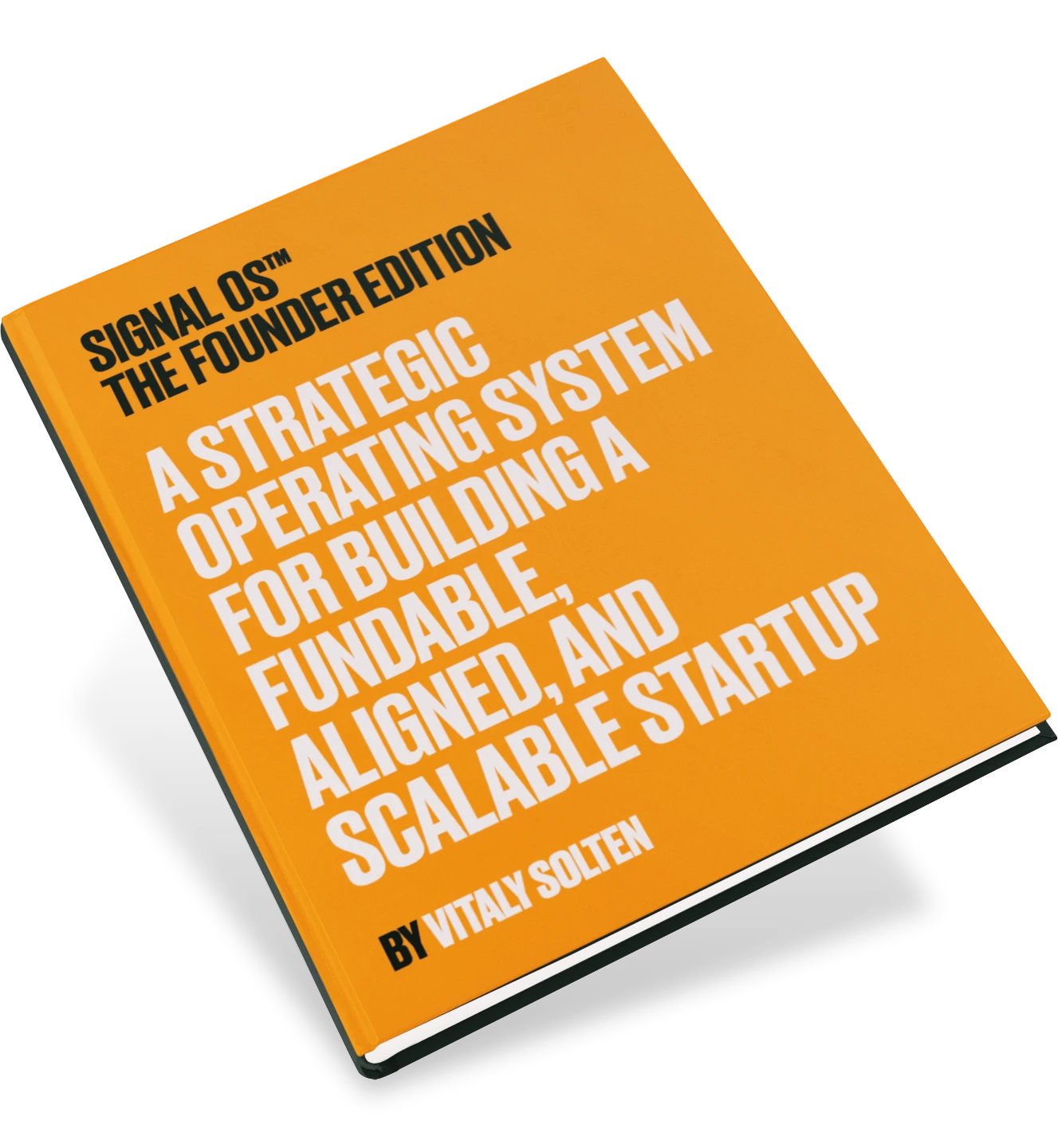
Signal OS™: The Founder Edition, Second Edition — Now Available

After working with founders, advisors, and startup mentors around the world, I’m excited to announce the Second Edition of Signal OS™: The Founder Edition — a self-guided strategic system designed to help you build an aligned, fundable, and scalable startup.

🚀 What’s New in This Edition?

  • Fully refined structure with expanded tools and clarity models
  • Updated Signal Audit with a visual scoring system
  • More misalignment patterns and case vignettes
  • Enhanced founder–investor alignment section
  • Streamlined tools for pre-raise readiness and clarity rituals

🧠 Why Signal OS Still Matters

Most founders don’t fail from lack of effort — they fail from misalignment.
Signal OS™ is built to help you detect blind spots before they cost you.

Whether you’re pre-seed or post-product, this system gives you a structured lens to:

  • Align with your co-founders
  • Understand what your traction actually signals
  • Communicate with investors more clearly
  • Build without confusion

📦 What You’ll Get

68+ pages of founder-first strategy
The full 5 Signals™ framework
Strategic Audit + Scorecard
Investor conversation prep sheet
Alignment tools + rituals
Signal Memo Template + 1-page canvas
And more

💬 What Founders Are Saying

“This made me step back and look at our startup with sharper eyes.”
“Helped us get aligned before fundraising — saved us months.”
“I wish I had this during our last pivot.”

🎯 Get the OS Now

The Second Edition is now available at https://vitalysolten.com/signal-os/

Whether you’re building your first startup or refining your next raise, Signal OS™ will help you build with clarity — not chaos.