PUBLIC RELEASE | 19 September 2026 | FULL ACCESS
Key thesis: The AI Energy Management Alliance marks the point at which compute flexibility begins to move from an operational feature into a proposed interconnection and financing product. Investors should underwrite flexible capacity by response, duration, availability, recovery, and control, not by a headline percentage.
| Field | Detail |
|---|---|
| Research ID | RA-0011 |
| Research type | Fundamental event-driven market structure report |
| Evidence cut-off | 19 September 2026 |
| Primary audience | Professional investors and strategy decision-makers |
| Analytical confidence | Moderate |
Executive conclusion
The launch of the AI Energy Management Alliance on 16 September is the most consequential AI-economy event of the week for long-horizon investors. The alliance itself does not create grid capacity. Its importance is that Google, NVIDIA, Emerald AI, Anthropic, utilities, and power producers are trying to standardize a new bargain: a data center may receive faster or larger access to constrained electricity systems if it can make a credible, measurable commitment to reduce its draw when the grid needs relief.[1], [3]
That bargain changes what investors must underwrite. A nominal megawatt describes the maximum electricity a campus expects to draw. It says nothing about whether that demand can be reduced in ten minutes, sustained for four hours, repeated during a heat wave, or verified without breaking customer service agreements. A flexible megawatt has a service specification. Quantity, notice, response, duration, availability, recovery, and control determine whether the grid can rely on it and whether lenders should recognize it.
The evidence is promising but narrower than promotional claims suggest. Google says it has integrated 1 GW of demand response into long-term U.S. utility contracts and can limit or shift a portion of machine-learning workloads.[4] A peer-reviewed field trial on a 256-GPU cluster reduced power by 25% for three hours while maintaining stated quality-of-service guarantees.[10] A separate peer-reviewed study using more than one million Alibaba tasks modeled up to 22% load shedding in selected flexibility windows.[11] None of those results proves that an entire hyperscale campus can deliver the same percentage across every hour, season, and workload mix.
The investment implication is practical. Time to power may become partly tradable against operating flexibility. Sites, cloud platforms and orchestration systems that can prove dependable load relief could obtain earlier interconnection, lower upgrade exposure or new tariff revenue. Facilities whose customer contracts, latency mix or financing require flat consumption may face a relative disadvantage. The control system joining workload scheduling to grid telemetry becomes a strategic asset because it determines whether a flexibility promise is operationally real and contractually bankable.
What changed
Data-center flexibility is not new. Demand response, backup generation, batteries, and workload shifting have been discussed for years. Three developments now move the subject from technical possibility toward market design.
First, AEMA has proposed technology-neutral, performance-based requirements rather than prescribing one hardware solution. Its launch materials identify response speed, duration, predictability, emergency behavior, standardized metrics, operational data sharing, risk-adjusted interconnection pathways, and cost allocation that reflects avoided upgrades.[1] Those are the terms of a service contract, not an efficiency pledge.
Second, the regulatory direction is becoming concrete. FERC's June order asked PJM and its transmission owners to address new services for large loads willing to limit withdrawals under specified conditions, as well as remote control, financial security, planning treatment, and protections against cost shifting.[5] Similar show-cause orders covered six organized market regions representing most FERC-jurisdictional load.[6] Final rules remain unsettled, but the question has moved onto the tariff agenda.
Third, commercial evidence now extends beyond pilots. Google says demand response is part of contracts with Indiana Michigan Power, Tennessee Valley Authority, Entergy Arkansas, Minnesota Power and DTE Energy, and describes flexibility as a way to connect new data centers more rapidly.[4] AEMA therefore arrives after an early contract base exists, not before it.
Exhibit 1 The service definition behind a flexible megawatt
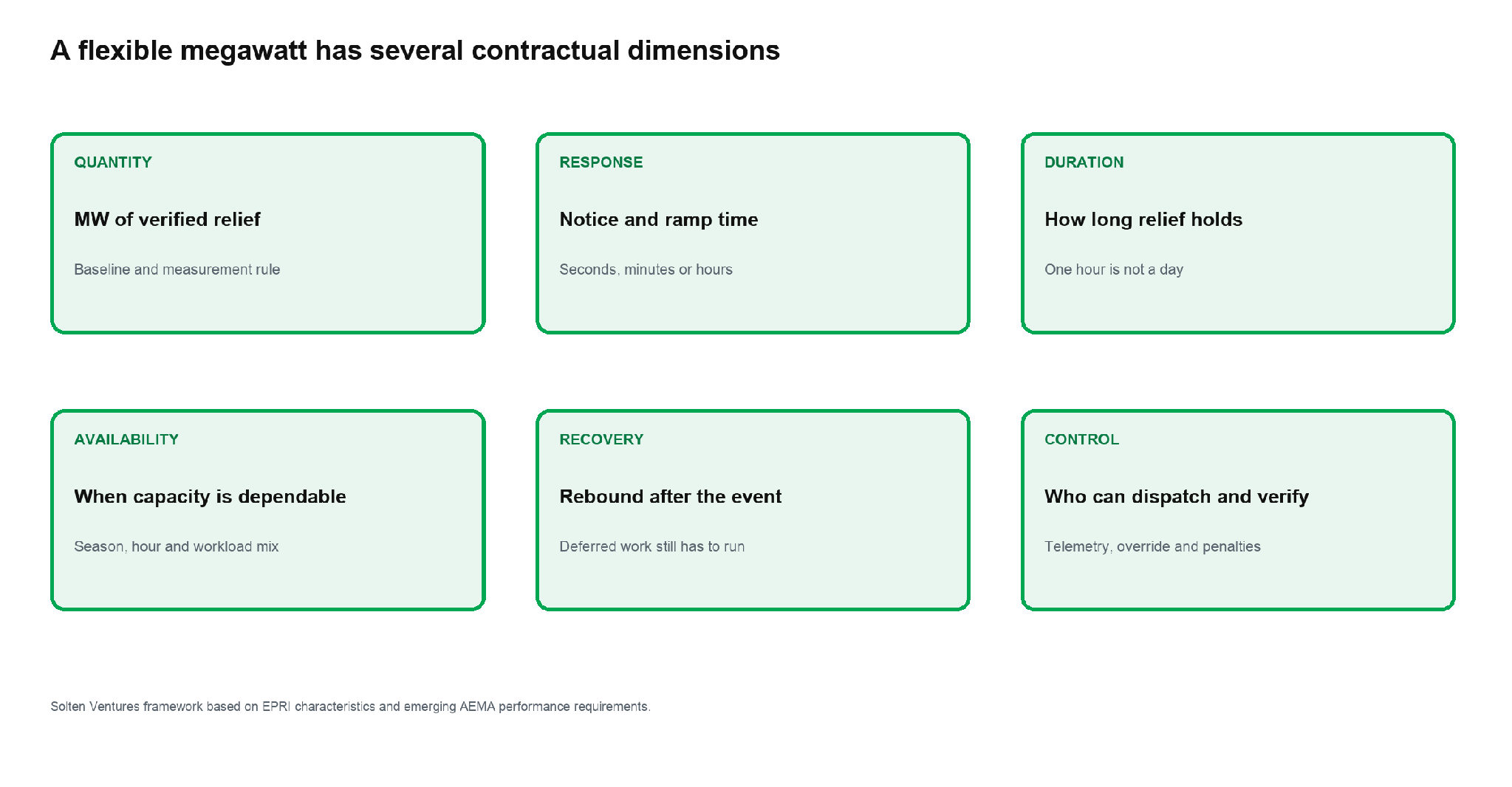
Source: Solten Ventures framework based on EPRI characteristics and AEMA performance requirements.[1], [9]
The economic mechanism
Power systems are built for the peak, not only for annual energy. A 100 MW campus operating continuously consumes 876,000 MWh a year. If it can reliably reduce draw by 20 MW for the 100 most constrained hours, the affected energy is only 2,000 MWh, or 0.228% of annual consumption. Yet the grid sees 20 MW of relief at the moment it matters. If the workload is shifted rather than cancelled, annual energy use may not decline at all.
This distinction explains why a small energy concession can have large infrastructure value. A utility may avoid or defer a peaking resource, transmission reinforcement, or emergency action. The developer may gain an earlier connection and begin earning revenue sooner. The value is not the retail price of 2,000 MWh. It is the avoided capacity, schedule, and reliability cost, adjusted for the probability that relief is available when called.
The difficult part is allocating that value. The workload owner decides whether a job can move. The cloud platform controls the scheduler. The data-center operator controls the site meter and physical plant. A utility or grid operator defines the event. A lender may have financed the project on a utilization assumption. Unless contracts align these parties, the operating entity asked to curtail may bear the cost while another entity receives the interconnection benefit.
Exhibit 2 A small annual energy shift can create meaningful peak relief
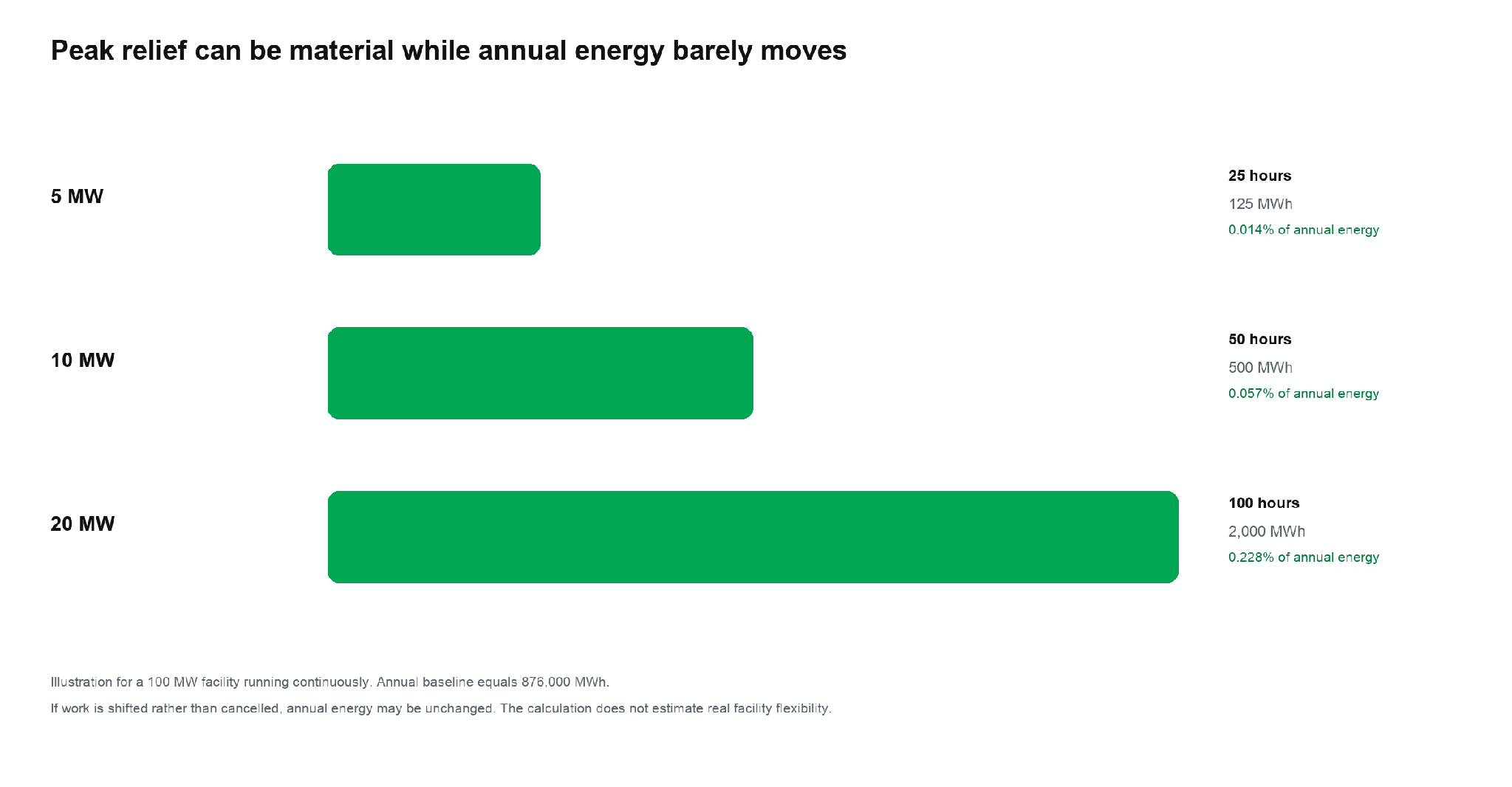
Source: Solten Ventures calculation. Assumes a 100 MW continuous load and no claim about actual site flexibility.
Evidence and its limits
The strongest public field evidence remains small relative to planned campuses. The Nature Energy demonstration involved 256 GPUs in Phoenix and sustained a 25% reduction for three hours without hardware modification or storage.[10] It shows that software can modulate a real AI cluster while protecting the tested service requirements. It does not establish a standard curtailment percentage for all facilities.
Trace studies widen the evidence but also expose the uncertainty. The Alibaba analysis found more than 20% of estimated GPU-side power associated with tasks considered deferrable and modeled up to 22% load shedding in selected windows.[11] A September preprint reconstructed a 155,410-GPU trace and reached a much lower dependable result: immediate eligible relief averaged 6.35% of median facility demand, and 95%-available relief declined as event duration increased.[12] The studies ask different questions and use different methods. Their disagreement is informative. Flexibility is a spectrum across duration and reliability, not one percentage.
The same caution applies to scale claims. AEMA says flexible AI could unlock an additional 100 GW from the existing U.S. grid and reduce a five-to-ten-year interconnection backlog.[2] This is a coalition objective, not an independently verified forecast. It should be treated as a statement of ambition until tariffs, operating data, and realized connection timelines provide evidence.
Investment implications
For data-center developers, flexibility may improve site value when it reduces the time or network investment required to energize capacity. The relevant diligence questions are contractual: which MW can be curtailed, at what notice, for how long, how often, with what telemetry, and with what penalty if performance fails. A marketing claim that a campus is 20% flexible is not enough.
For cloud platforms, multi-region workload orchestration becomes an economic capability. A platform with diverse geography and a deep mix of batch, training, and elastic inference can shift work away from a constrained region. A single-site operator with latency-sensitive colocation customers has less room. This could widen the advantage of hyperscalers unless independent orchestration products let smaller operators pool capacity.
For software and equipment investors, the control layer spans schedulers, telemetry, power prediction, workload classification, batteries, uninterruptible power systems, cooling controls, and utility interfaces. The winning product will need to verify performance under contract, not merely optimize an electricity bill. Interoperability and audit trails may matter as much as the optimization algorithm.
For infrastructure lenders and equity investors, flexibility can support earlier revenue but may introduce operating and covenant risk. Debt sizing should not give full credit to a flexible-load commitment until dispatch rights, measurement, penalties, rebound obligations, and customer SLAs are reconciled. The economic benefit should be tested against the lost margin from delayed compute and any extra capital required for storage or generation.
Exhibit 3 The party providing flexibility may not capture its value
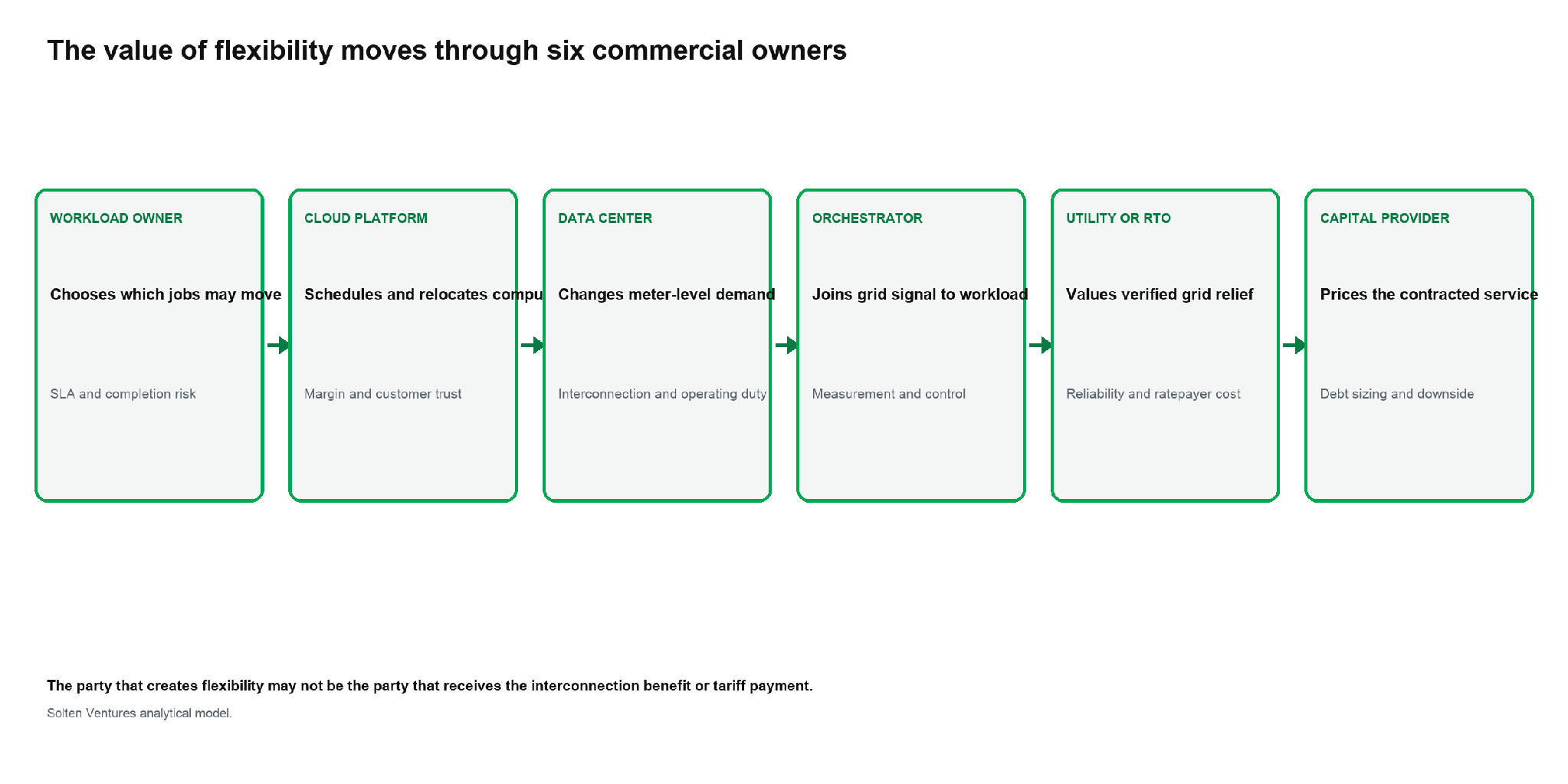
Source: Solten Ventures analytical model.
The strongest counter thesis
The counter-thesis is that flexibility will remain a useful but narrow operating tool rather than a new financing category. AI compute is unusually capital intensive. The IEA notes that an AI-focused data center is roughly ten times more capital intensive than an aluminium smelter, making curtailment expensive.[7] Low-latency inference cannot simply pause, and long training runs may lose economic value when delayed. Colocation operators often do not control tenant workloads. Utilities may also prefer firm generation and network upgrades to a novel resource whose performance depends on proprietary software.
This view would dominate if tariff credits are too small to compensate for lost compute margin, if flexibility commitments do not shorten connection schedules, or if repeated events cause material rebound peaks and customer-service failures. It would also gain support if utilities demand direct control that cloud operators will not accept, or if regulators refuse to recognize load relief in planning and cost allocation.
The current evidence does not resolve the issue. It supports software-level capability and early contracting, while leaving campus-scale firmness, event frequency, portfolio effects and default remedies largely undisclosed. The main thesis is therefore conditional: flexibility becomes a financial attribute only when a utility can rely on it and a project can earn more from the resulting access than it loses from operational constraint.
Key takeaways
- The launch of AEMA matters because the proposed product is a measurable grid service tied to interconnection and cost allocation.
- A flexible megawatt must be specified by quantity, response time, duration, availability, recovery, and control. A single percentage hides the risk.
- Peak relief can have large capacity value even when it affects little annual energy, so the benefit cannot be evaluated from electricity savings alone.
- The commercial value may accrue to a different party from the one that bears workload and SLA risk. Contract design is central.
- Field evidence proves feasibility in bounded settings. It does not yet prove a universal or campus-scale flexibility factor.
What to watch
- Tariffs or interconnection agreements that specify flexible large-load service, including response, duration, event limits, penalties and upgrade-cost treatment.
- Evidence that flexibility shortens a real connection timeline or avoids a quantified network investment, rather than merely earning operating payments.
- Portfolio-level performance data showing delivered MW by event duration and confidence level, including rebound after the event.
- Customer contract changes that give cloud or data-center operators authority to shift workloads without breaching service levels.
- Independent disclosure of lost compute margin, incentive payments and capital cost for storage, generation or control systems.
- Regulatory treatment of emissions, especially where flexibility shifts demand toward fossil baseload generation. A peer-reviewed U.S. model found system cost reductions in every region studied but higher emissions in some cases.[14]
Sources and evidence
Evidence cut-off 19 September 2026. Sources were accessed on or before the cut-off. Coalition and company statements establish what those organizations announced; they do not independently verify future grid capacity, savings or adoption.
S01. NVIDIA. Emerald AI, Google and NVIDIA Launch Alliance to Advance Flexible AI Data Centers. Primary company announcement. 16 Sep 2026. Source
S02. AI Energy Management Alliance. About AEMA. Primary coalition statement. Accessed 19 Sep 2026. Source
S03. Axios. Google, Nvidia and Emerald AI launch flexible data center power coalition. High-quality secondary. 16 Sep 2026. Source
S04. Google. Google signed 1 GW of data center demand response. Primary company disclosure. 19 Mar 2026. Source
S05. Federal Energy Regulatory Commission. PJM large-load show-cause order in Docket EL26-67-000. Primary regulatory text. 18 Jun 2026. Source
S06. Federal Energy Regulatory Commission. Commissioner Rosner remarks on large-load show-cause orders. Primary regulatory statement. 18 Jun 2026. Source
S07. International Energy Agency. Key Questions on Energy and AI executive summary. Authoritative intergovernmental analysis. 2026. Source
S08. Lawrence Berkeley National Laboratory. 2024 United States Data Center Energy Usage Report. Primary government laboratory report. Dec 2024. Source
S09. Electric Power Research Institute. Grid Flexibility Needs and Data Center Characteristics. Industry research white paper. Jun 2025. Source
S10. Nature Energy. AI data centres as grid-interactive assets. Peer-reviewed field demonstration. 5 Dec 2025. Source
S11. International Journal of Electrical Power and Energy Systems. Data center workload flexibility for power system demand response. Peer-reviewed trace-based modeling. May 2026. Source
S12. arXiv. Beyond Scalar Flexibility From Eligible AI Workloads to Dependable Load Relief. Preprint and trace reconstruction. 4 Sep 2026. Source
S13. EPIC University of Chicago. Quantifying AI data center flexibility as a resource adequacy asset. Working paper. 28 Jul 2026. Source
S14. iScience. Flexible data centers reduce power system costs but can increase emissions. Peer-reviewed power-system model. 26 Jun 2026. Source
S15. NVIDIA. NVIDIA and Emerald AI join energy companies to pioneer flexible AI factories. Primary company announcement. 23 Mar 2026. Source
S16. Google. A new frontier for data center demand response. Primary company disclosure. 4 Aug 2025. Source
S17. Electric Power Research Institute. Win Win Watts. Industry economic analysis. Jan 2026. Source
Research disclosure
This publication is independent research for informational purposes. It is not investment, legal, tax, accounting, or engineering advice and does not recommend a security, project, or transaction. The analysis relies on public information available by the evidence cut-off. Company and coalition projections are identified as such. Scenario ranges are analytical tools, not forecasts.
Request a full version of the research: https://soltenventures.com/research-access
About Solten Ventures
Solten Ventures brings together independent research, investment systems, company diagnostics, and business performance analysis under one institutional identity. The common layer is disciplined analytical judgment: understanding what is changing, what the evidence supports, what remains uncertain, and what deserves attention before making consequential decisions.
Contact hello@soltenventures.com | soltenventures.com
Confidentiality soltenventures.com/policies/confidentiality.pdf